Best time to fish · Mid May to September 30
The fish are here all season. What changes is where you find them and how deep. Here’s where walleye, northern pike and lake trout go from the opener in mid May to September 30 on Sydney and Kilburn Lakes, and when the heaviest fish come.


32″ walleye, end of June · Sydney Lake
Apr 25–May 10
typical ice-out
One to two weeks before the opener. Kilburn’s dark bays warm first; Sydney’s deep basin warms slowly.
May 15
2027 walleye opener
The third Saturday in May. Camp opens the Friday before, and we fish until September 30.
16½ h
of daylight in June
Sunrise about 5:05 a.m. and sunset about 9:35 p.m. at camp, with fishing light past 10.
Sept
our biggest fish of 2025
The season’s biggest walleye, northern pike and lake trout were all caught in September.


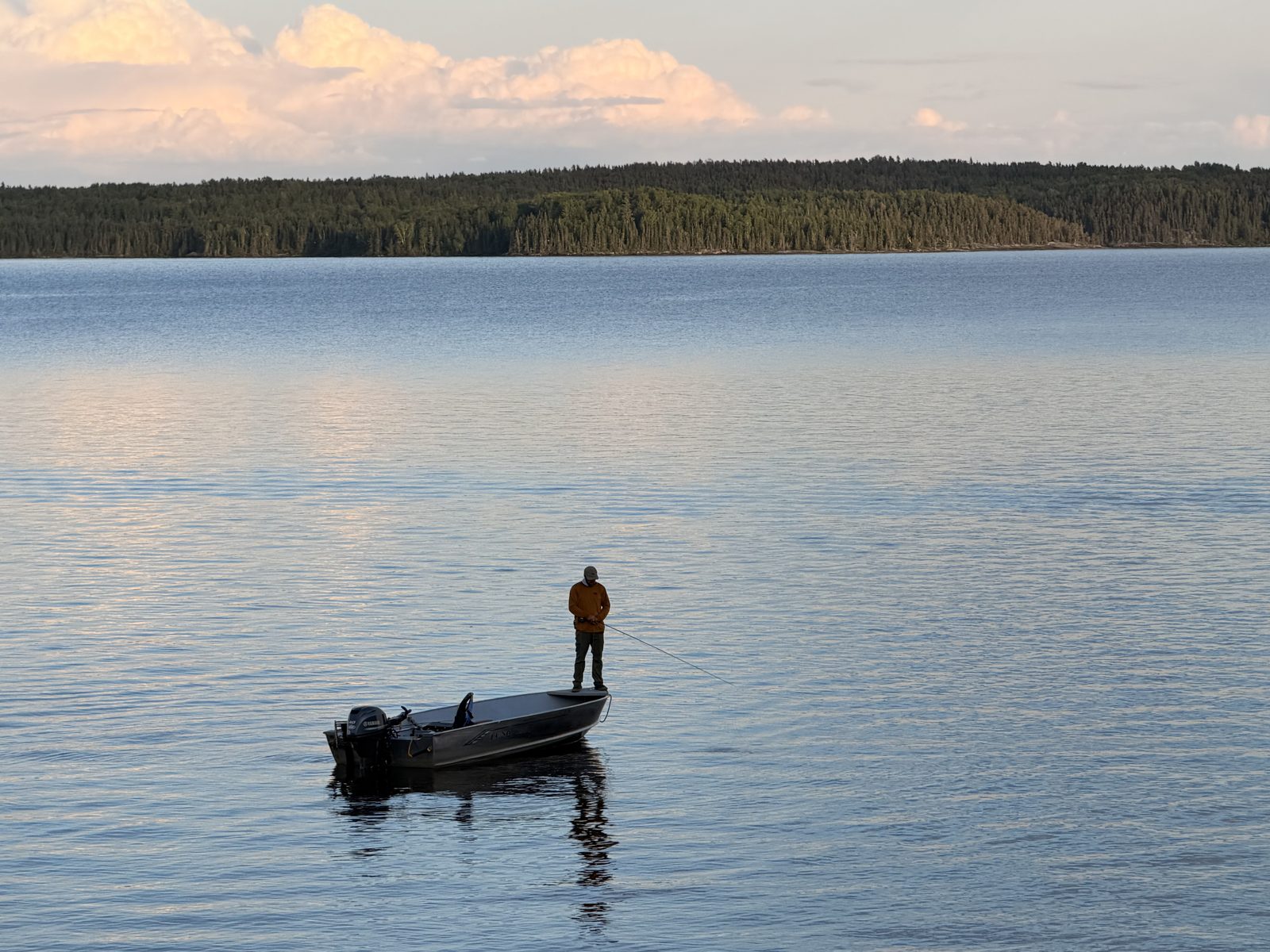
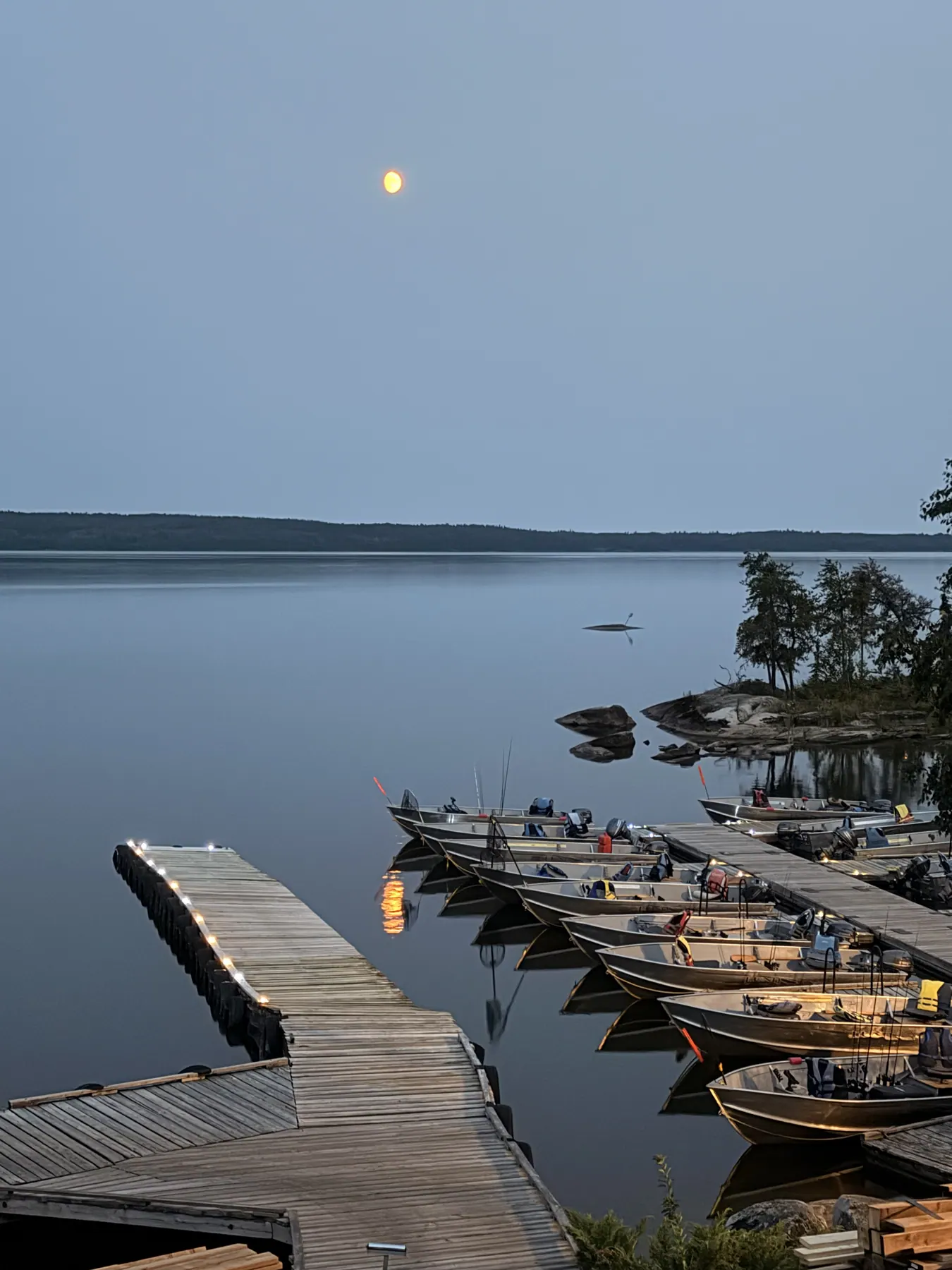
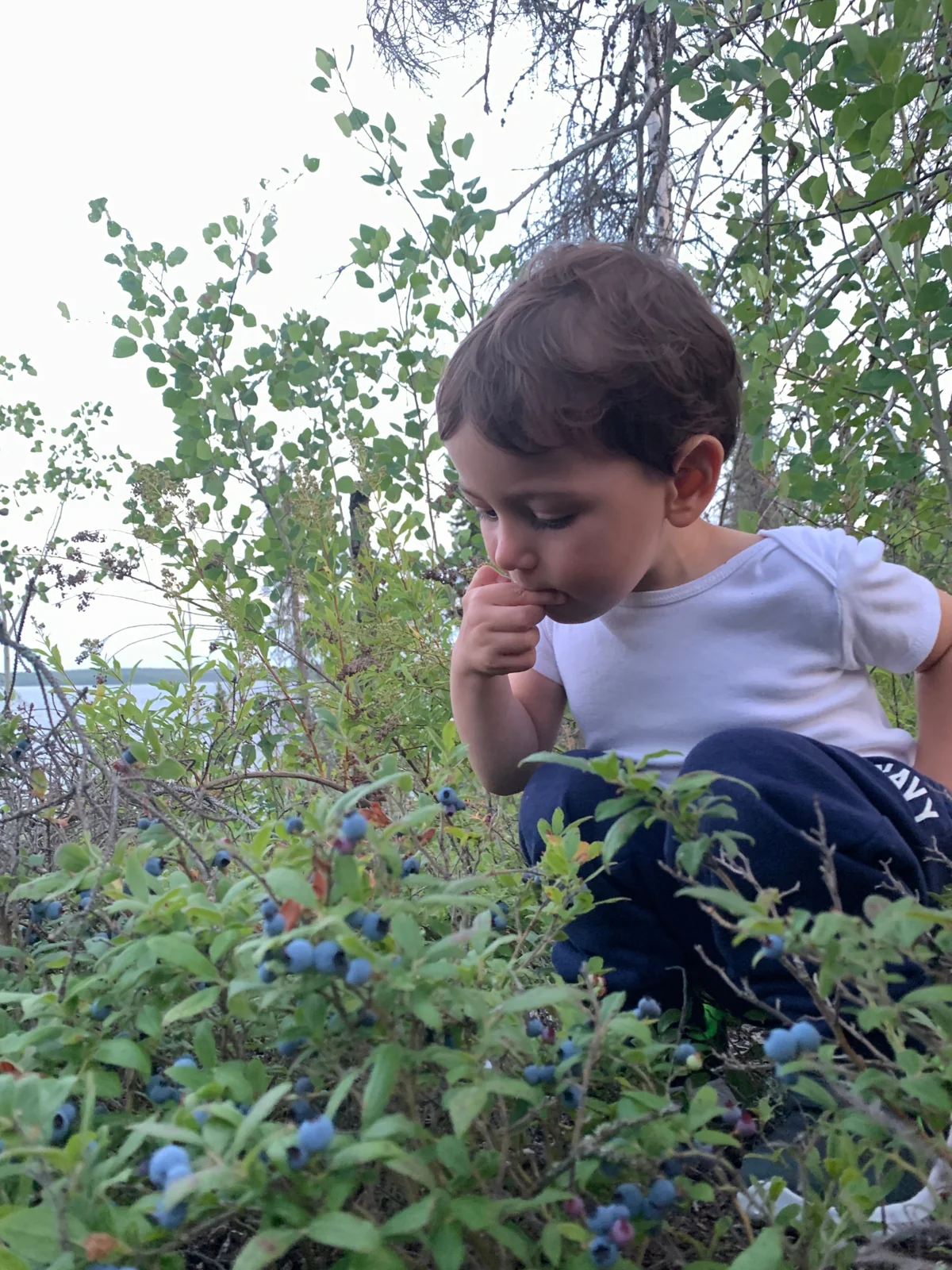
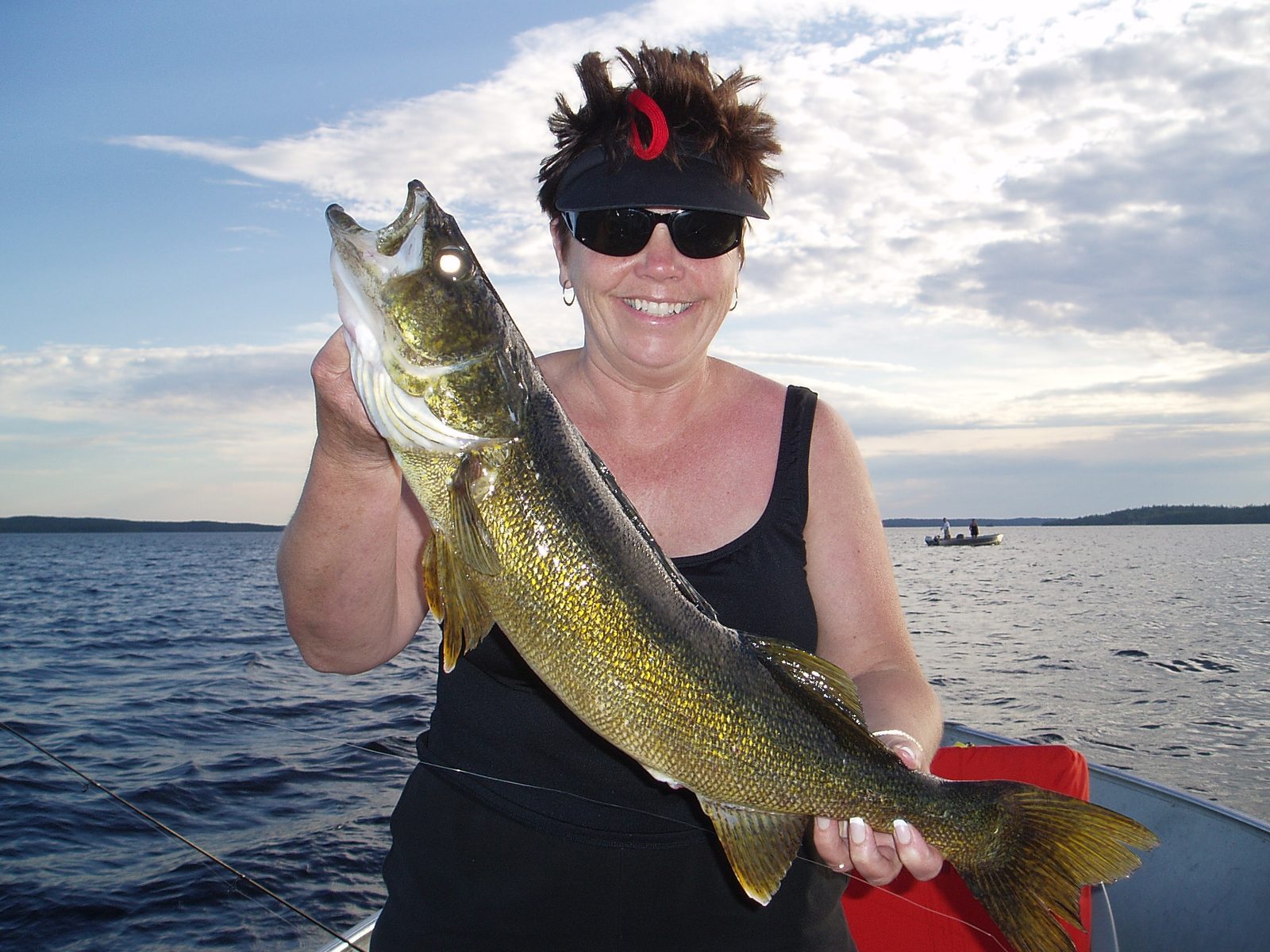

The short answer
Any week from the opener in mid May to September 30 is a good time to fish here. The walleye, pike and lake trout don’t leave; they move. Pick the week that suits your group and fish where the fish are that month. The one real difference: for a trophy, late August and September give you the heaviest fish.
| What changes | May | June | July | August | September |
|---|---|---|---|---|---|
| Walleye | Creek mouths, current and dark bays · 3–10 ft | Shallow bays, mud flats, new weeds · 6–12 ft | Deep bay edges, then points and reefs · 10–25 ft | Saddles, humps, mid-lake reefs · 18–30 ft | Deep flats, humps and points next to deep water · 23–32 ft |
| Northern pike | Shallow weedy bays and creek mouths · 2–10 ft | Weed edges and points outside the bays · 4–12 ft | Big pike on deep weed edges, rocky points, reefs · 10–25 ft | Near deep water and cisco; shallow early and late | Rocky shorelines and narrows to deep water |
| Lake trout | Shallow, even from shore · surface to 45 ft | Dropping; jigging from mid-June · 25–60 ft | Plateau edges · 40–70 ft | Deepest of the year · 50–70 ft, big ones to 120 ft | About 70 ft on Sept 1, up about 15 ft a week · on the shoals by the last week |
| Surface water | 45–55 °F (7–13 °C) | 55–68 °F (13–20 °C) | 68–75 °F (20–24 °C) | 68–73 °F (20–23 °C) | 64 → 55 °F (18 → 13 °C) |
| Trophy weight | Spawned out and feeding | Putting on weight | Putting on weight | Getting heavy by late August | Heaviest of the season |
| Bugs | Blackflies start late in the month | Blackflies and mosquitoes, the buggiest month | Mosquitoes at dawn and dusk, deer flies on hot afternoons | Few after mid-month | Few to none |
| Daylight | 15½ hours | 16½ hours | 16 hours | 14½ hours | 12½ hours |
| Kenora high / low | 61 / 42 °F (16 / 6 °C) | 71 / 54 °F (22 / 12 °C) | 76 / 59 °F (24 / 15 °C) | 74 / 57 °F (23 / 14 °C) | 63 / 47 °F (17 / 9 °C) |
| Extras | Fresh green leaves, bears on the creeks, geese heading north | Longest days, fishing light past 10 p.m. | Swimming weather, moose on the shore, first blueberries | Blueberries, loons in big groups, northern lights return | Fall colours, northern lights, geese heading south |
Typical ranges, not promises; a late spring or a hot summer shifts things a week or two. Water temperatures are typical for northwestern Ontario lakes (Kilburn’s dark bays warm first, Sydney’s deep basin last). Daylight is mid-month at camp; weather is Kenora’s 1991–2020 average.
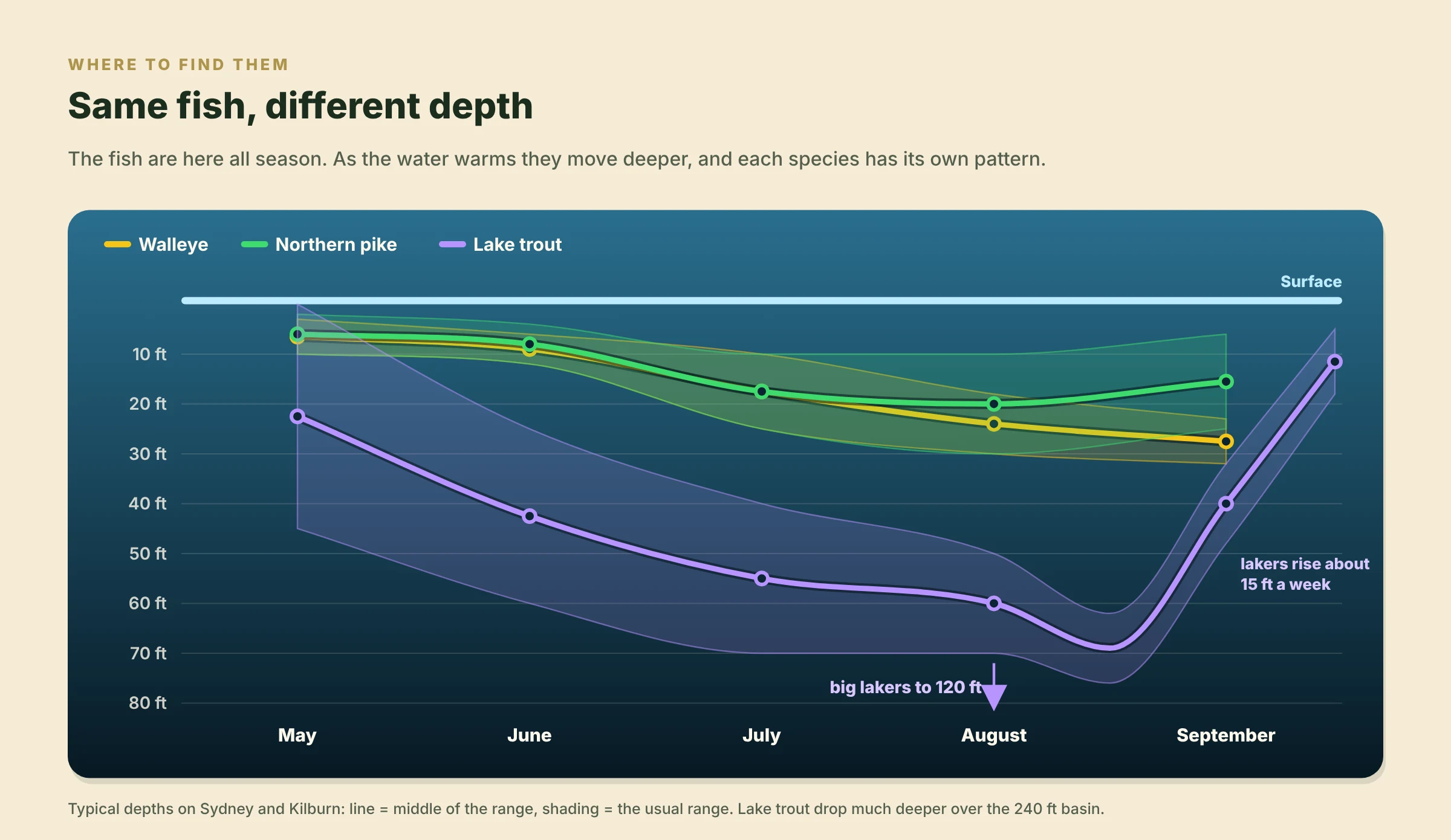
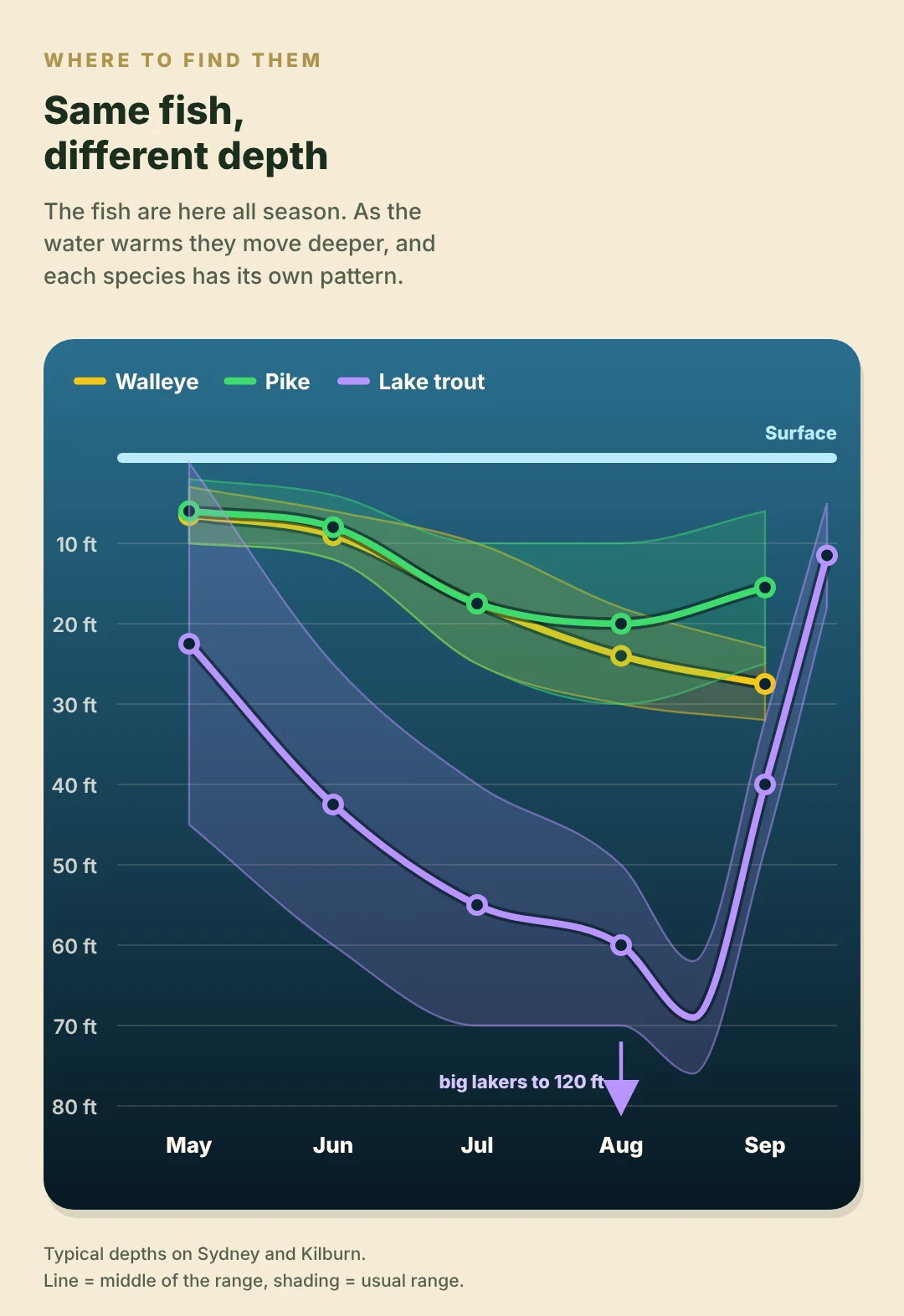
In numbers: walleye 3–10 ft in May, 6–12 ft in June, 10–25 ft in July, 18–30 ft in August and 23–32 ft in September. Northern pike 2–10 ft in May, 4–12 ft in June, 10–25 ft in July, 10–30 ft in August and 6–25 ft in September. Lake trout from the surface to 45 ft in May, 25–60 ft in June, 40–70 ft in July and 50–70 ft in August, deepest in late August (about 62–76 ft), then 32–48 ft in mid-September and 5–18 ft on the shoals by late September.
Mid to late May · water about 45–55 °F (7–13 °C)
Ice-out comes between April 25 and May 10 almost every year. Walleye spawn on rock and gravel near the creek mouths as the water warms through the 40s °F, and the opener is timed to land as the spawn wraps up. On opening weekend they’re bunched up, hungry and shallow.
Walleye
3–10 ft · the first drop-off to 15 ft
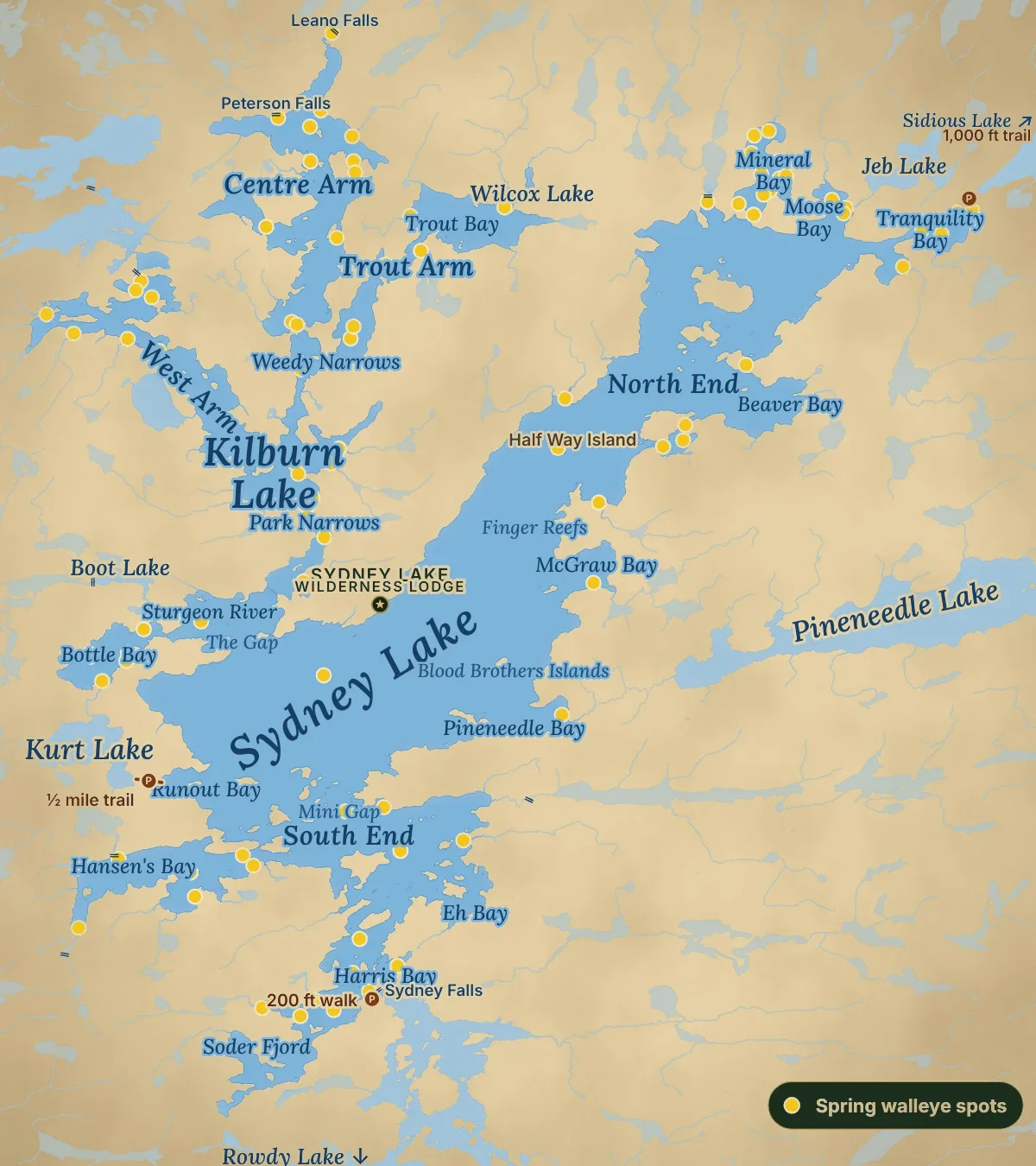
Start where creeks push current into the lake, then work the dark bays that warm first: Kilburn’s arms and Mineral, Tranquility, Hansen’s and Bottle Bays. Bigger fish often sit on the first drop-off outside the bay.
Look for water near 50 °F (10 °C). An onshore wind piles warm water and baitfish against one shoreline.
Try: 1/8–1/4 oz jigs with a minnow, fished slowly; crankbaits where shallow meets deep.
Northern pike
2–10 ft · close to the walleye
Pike spawn first, right after ice-out. By the opener they’re hungry and cruising the same warm bays and creek mouths as the walleye.
Try: a spoon or jerkbait along the edge of a walleye bay.
Lake trout
Surface to 45 ft · cold top to bottom
The whole lake is cold, so lakers roam shallow. Cast off the rocks at camp early, or troll spoons 25 to 45 feet down.
Try: a 1 oz spoon off a rocky point at first light.
Trip notes: Frosty mornings and warm afternoons, fresh green leaves, black bears along the spawning creeks and geese heading north. Blackflies show up late in the month.
Spring walleye spots ⤢June · water about 55–68 °F (13–20 °C)
The bays warm quickly and the walleye settle into them. Weeds grow, baitfish move shallow, and late in the month the big Hexagenia mayflies hatch off the soft-bottom flats. These are the longest days of the year.
Walleye
6–12 ft · in the bays and on the mud flats
Most walleye stay in the shallow, tea-stained bays, on the mud flats and along the rocky shores beside them. Troll the shoreline until you hit a school, then stop and jig.
When the mayflies hatch, usually late June or early July, walleye spread across the flats to eat the larvae. Slow trolling finds them faster than sitting still.
Try: a spinner and minnow trolled slowly over the flats.
Northern pike
4–12 ft · just outside the bays
Pike set up on weed edges, bay mouths and points next to deeper water. Big pike are most comfortable at about 61–70 °F, so they start drifting deeper as the shallows warm toward 70 °F.
Try: a spinnerbait rolled over the new weeds.
Lake trout
25–60 ft · jigging starts mid-June
Once the surface passes the upper 50s °F (about 14 °C), lakers leave the shallows. From mid June, jig the edges of flat plateaus in 40 to 60 feet.
Try: a tube jig or airplane jig on the plateau edge.
Trip notes: The buggiest month: blackflies and mosquitoes overlap early in the month, so bring repellent and a head net. Blackflies are usually gone by mid-June. June is also usually the wettest month, with more than 16 hours of daylight.
Spring walleye spots ⤢July · water about 68–75 °F (20–24 °C)
Swimming weather, moose along the shore and long, warm evenings. As the shallows heat up, the walleye don’t leave: they slide deeper, then out toward the main lake. Fishing in Canada in July means following them out.
Walleye
10–25 ft · shallower at dusk
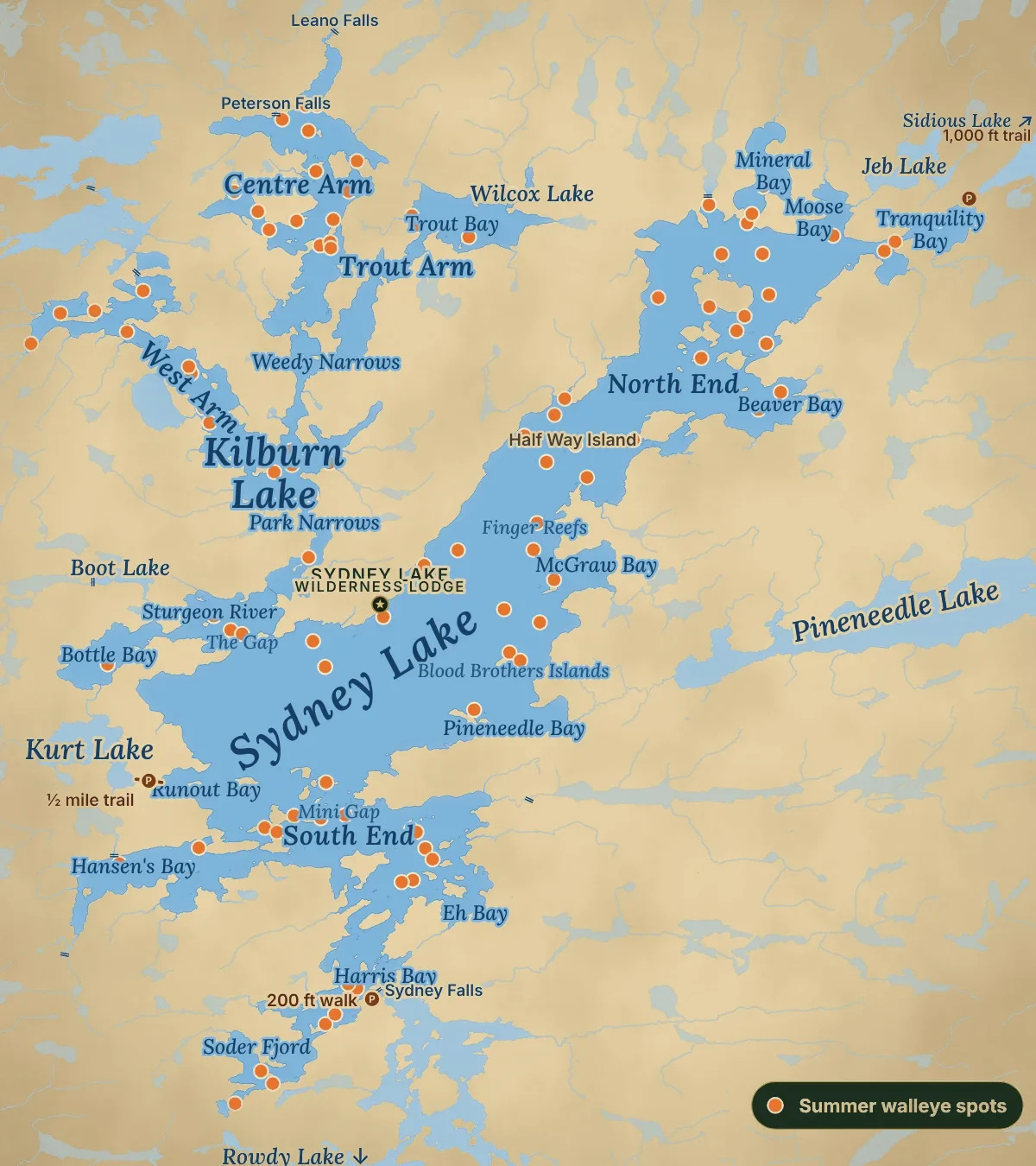
Early in the month, try the deeper water at the bay mouths. By mid July most walleye are on main-lake points, reefs, sunken islands and sharp breaks, holding deep in bright sun and moving up to feed in low light, wind and cloud.
Walleye are comfortable in water of about 64–72 °F, so on bright days it’s the sun as much as the heat that pushes them deeper. Kilburn’s tea-stained bays and narrows hold walleye shallower all month, a good bet on bright, calm days.
Try: a jig on the windy side of a point, or a spinner back-trolled along the break.
Northern pike
10–25 ft · deep weed edges and rocky points
Smaller pike stay in the warm, weedy bays. Big ones look for cooler water, about 61–70 °F: the deepest weed edges, rocky points that drop fast, reefs and narrows. Cast to the deep side of every point.
Try: a big spoon counted down off a rocky point.
Lake trout
40–70 ft on plateau edges
Lake trout do best in water of about 46–54 °F (8–12 °C), so they live below the warm surface layer. Jig or troll the edges of 50 to 70 foot plateaus.
Try: a tube jig dropped straight down on fish you see on the depth finder.
Trip notes: The warmest month. Blackflies are gone, mosquitoes linger at dawn and dusk, deer flies come out on hot afternoons, and wild blueberries start to ripen on the rock ridges late in the month.
Summer walleye spots ⤢August · water about 68–73 °F (20–23 °C), cooling late
The deepest month for walleye and lake trout. The lake is layered, warm on top and cold below, and the cisco (tullibee) in Sydney’s deep basin pull walleye and big pike out to mid-lake structure. By month’s end the nights are cooler and the fish are getting heavy.
Walleye
18–30 ft · some deeper, some suspended
Look for saddles between two pieces of structure, main-lake humps and reefs, and the deep edges of points. Walleye school there and roam out after cisco; some suspend over deep water.
The windy side of a reef usually has the active fish. A Garmin depth finder, for rent at camp, makes the humps easy to find.
Try: a 3/8–1/2 oz jig, or a spinner back-trolled along the break.
Northern pike
10–30 ft · shallow early and late
Big pike stay near cool, deep water and the cisco: rocky points, reefs and narrows off the main basin. Morning and evening they hunt the shallows next to deep water.
Try: topwater over the weeds on a calm evening.
Lake trout
50–70 ft · the biggest to 90–120 ft
Lakers hold on deep plateau edges over Sydney’s 240-foot basin. The biggest may sit 90 to 120 feet down.
Try: a bright 8-inch Flatfish with 3–6 oz of weight.
Trip notes: Bugs fade by mid month. Blueberries are ripe, loons gather in big groups, and the northern lights return once the nights get dark.
Summer walleye spots ⤢September · water cooling from about 64 °F to the mid 50s (18 → 13 °C)
Cooler, quieter and nearly bug-free, and the fish are at their heaviest. The walleye hold deep on structure, big pike work the points and narrows, and the lake trout come up about 15 feet a week, from around 70 feet at the start of the month to the rocky shoals by the last week. By late September, in spots like the Mini Gap, you can catch walleye, pike and lake trout without moving the boat.
Walleye
23–32 ft · on structure next to deep water
Most walleye hold deep in September, 23 to 32 feet down on flats, humps and points that drop into deep water, close to the cisco. Find the school on your depth finder, then jig or drag a rig right on the bottom.
They sit tight to the bottom, so drift or back-troll slowly. Kilburn’s big-island flat in 22 to 26 feet is a fall favourite.
Try: 1/4–1/2 oz jigs in pink and white, slow, on flats beside deep water.
Northern pike
Rocky shores · narrows to deep water
As the weeds die back, big pike move to rocky main-lake shores, points and narrows that lead to deep water, like The Gap. Keep a leader handy when trout fishing.
Try: a suspending jerkbait along a rocky shore.
Lake trout
About 70 ft to start · up 15 ft a week · shoals by the last week
Lakers come up as the lake cools: about 70 feet down at the start of September, then roughly 15 feet shallower each week. By the last week they gather on boulder patches, reefs and rocky shores before spawning, which mostly happens after the season closes.
Try: a bright Little Cleo cast toward shore and worked back out.
Trip notes: Bring warm layers and gloves. Birch and aspen turn gold, the northern lights are often out late, and geese head south. Lake trout season, and ours, closes September 30.
Lake trout spots ⤢
Trophy timing
In 2025, our biggest walleye, our biggest northern pike and our biggest lake trout of the season were all caught in September. The walleye was Bob Mangaudis’ 31-incher. The lake trout was Roger Anderson’s 40½-incher on September 24, the biggest lake trout in all of Ontario’s Trophy Waters that year.
That fits what I’ve seen over the years, and the biology backs it up. Fish in northern lakes do most of their growing in the open-water months, so by late August they have a whole summer of feeding behind them. Fall is also when the next spawn starts to build: walleye store fat over the summer and grow their eggs through fall and winter, pike eggs start developing in midsummer, and lake trout spawn in the fall, so a big female in late September is carrying nearly ripe eggs.
As the water cools, baitfish move back toward the shallows and the big fish follow them to feed before winter. Big fish come in every month, but if a trophy is the main goal, late August and September put the odds on your side.
Trophy sizes in Ontario’s Trophy Waters: walleye 27″, northern pike 38″ and lake trout 32″, measured nose to pinched tail and released alive.
Ontario’s Trophy Waters →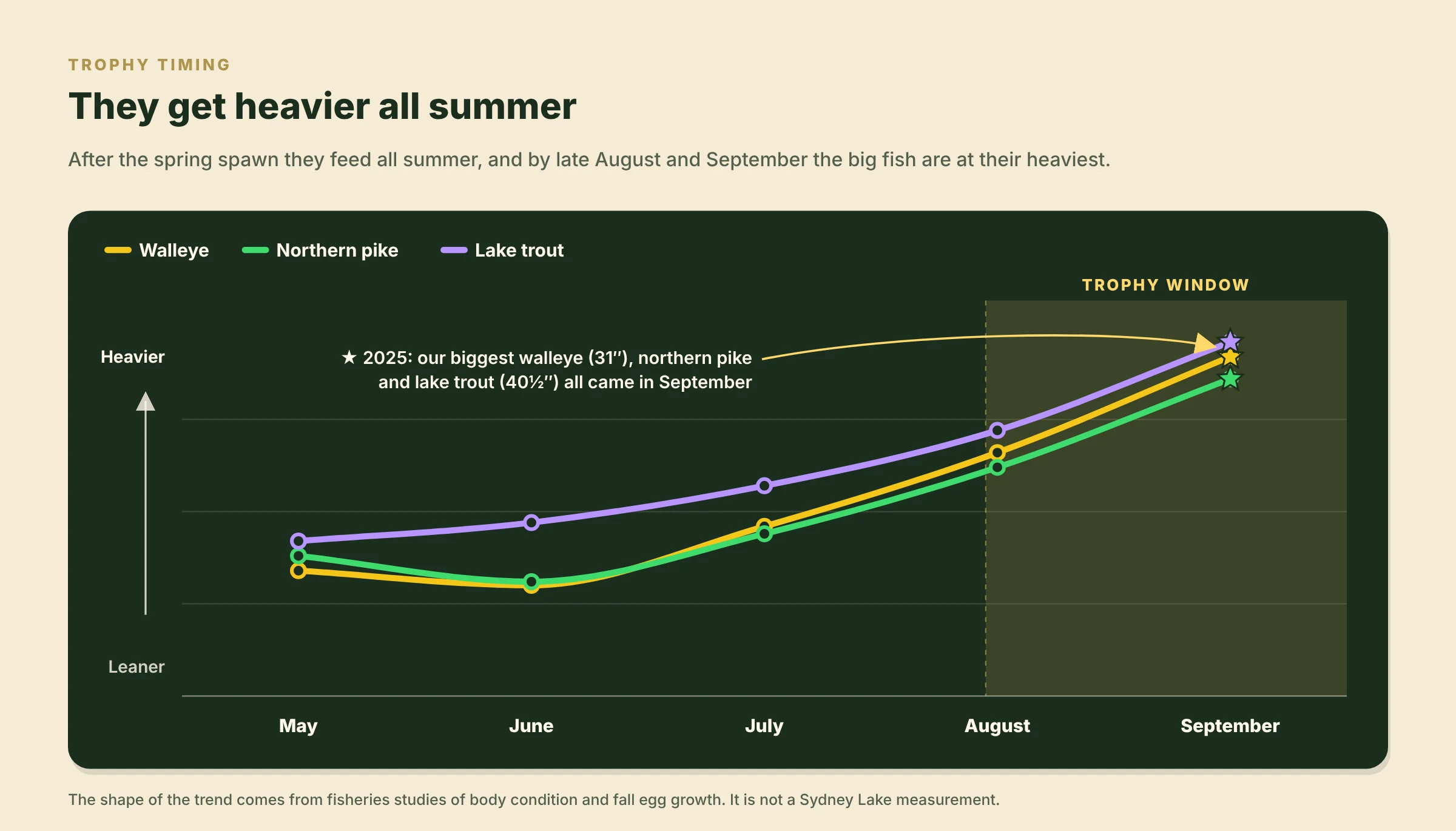
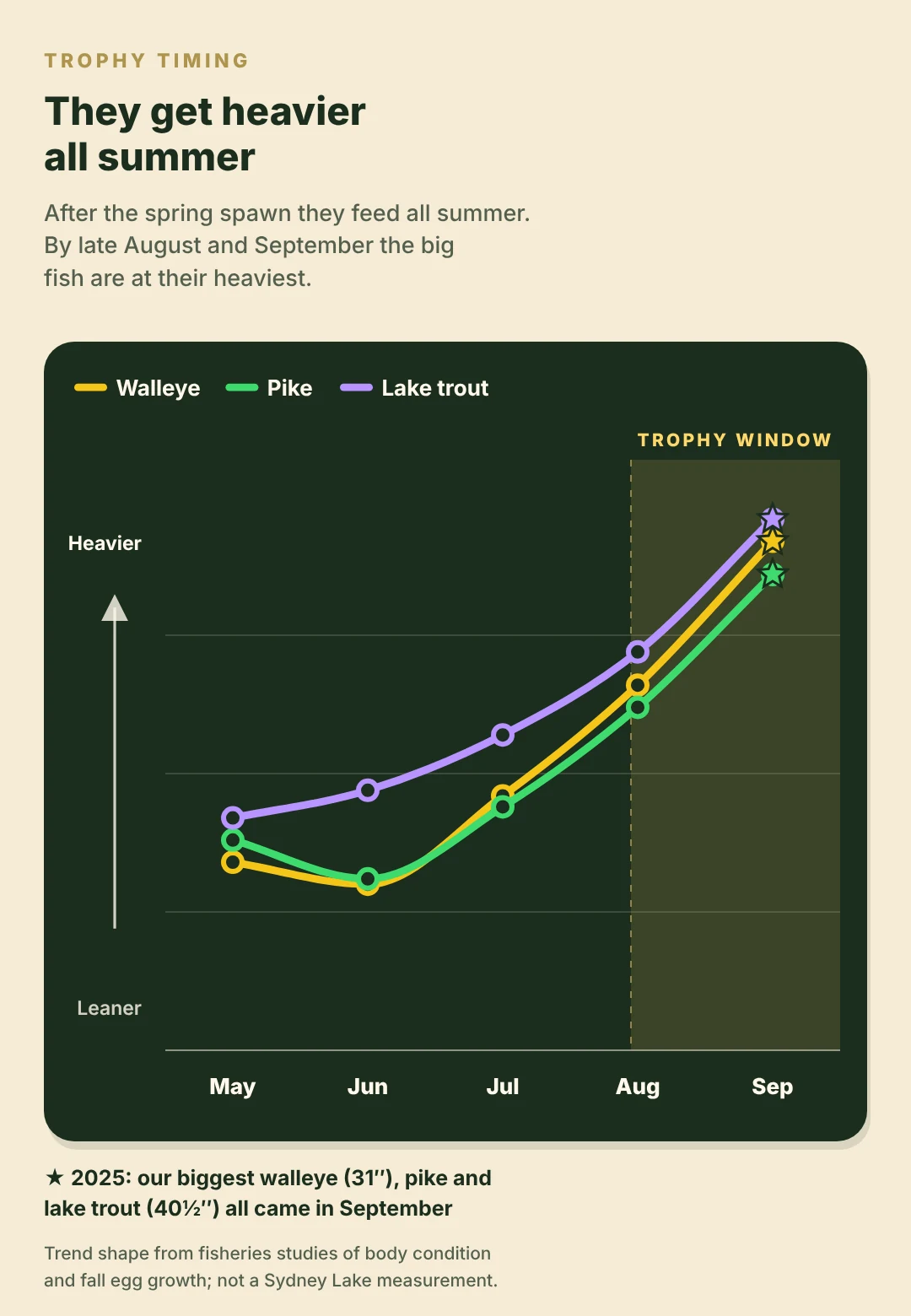
In numbers: the chart shows relative condition, not weights. Walleye and pike dip in June after the spring spawn; then all three species gain through July and August and are heaviest in September. Our biggest walleye, northern pike and lake trout of 2025 were all caught in September.
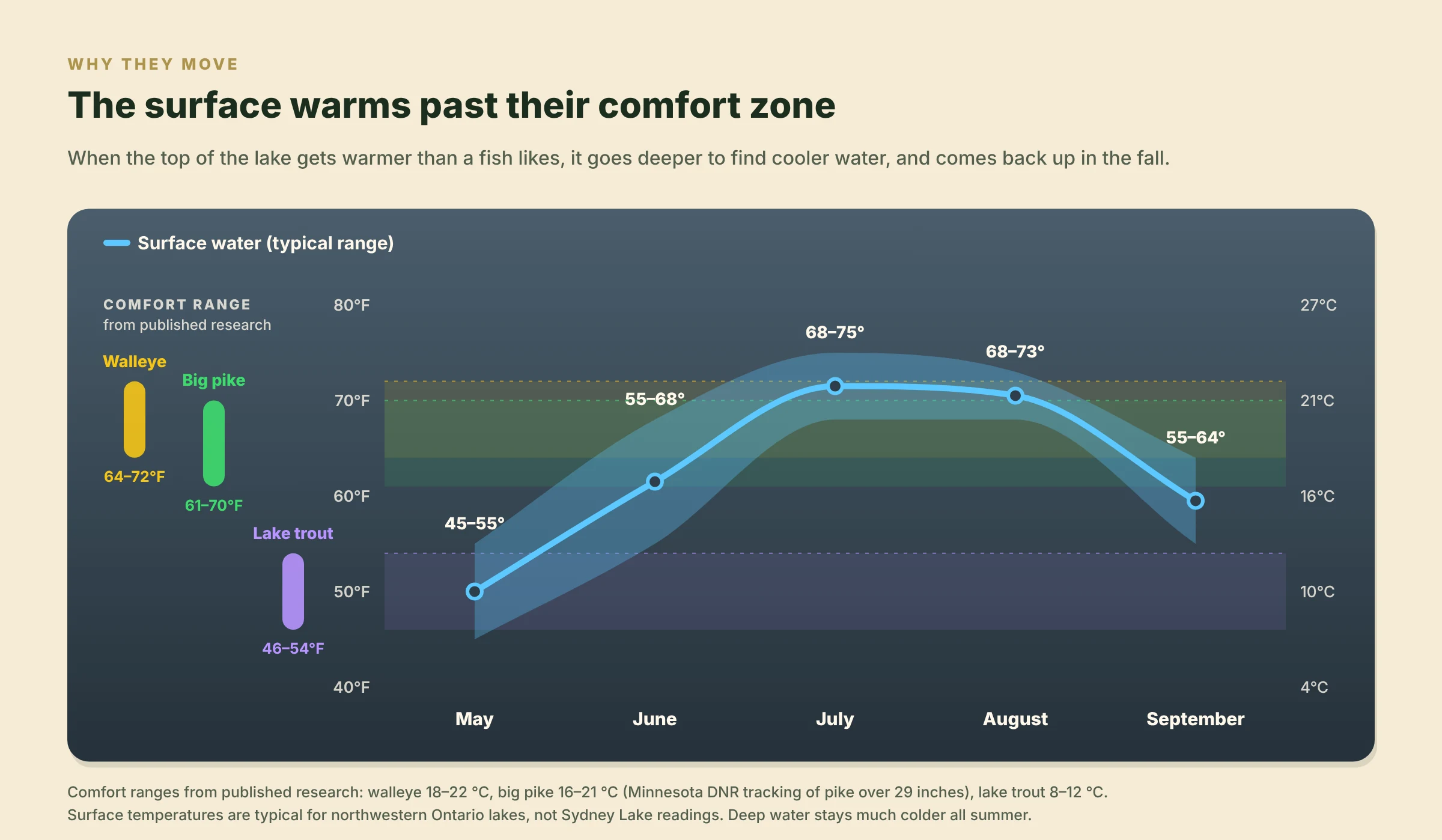
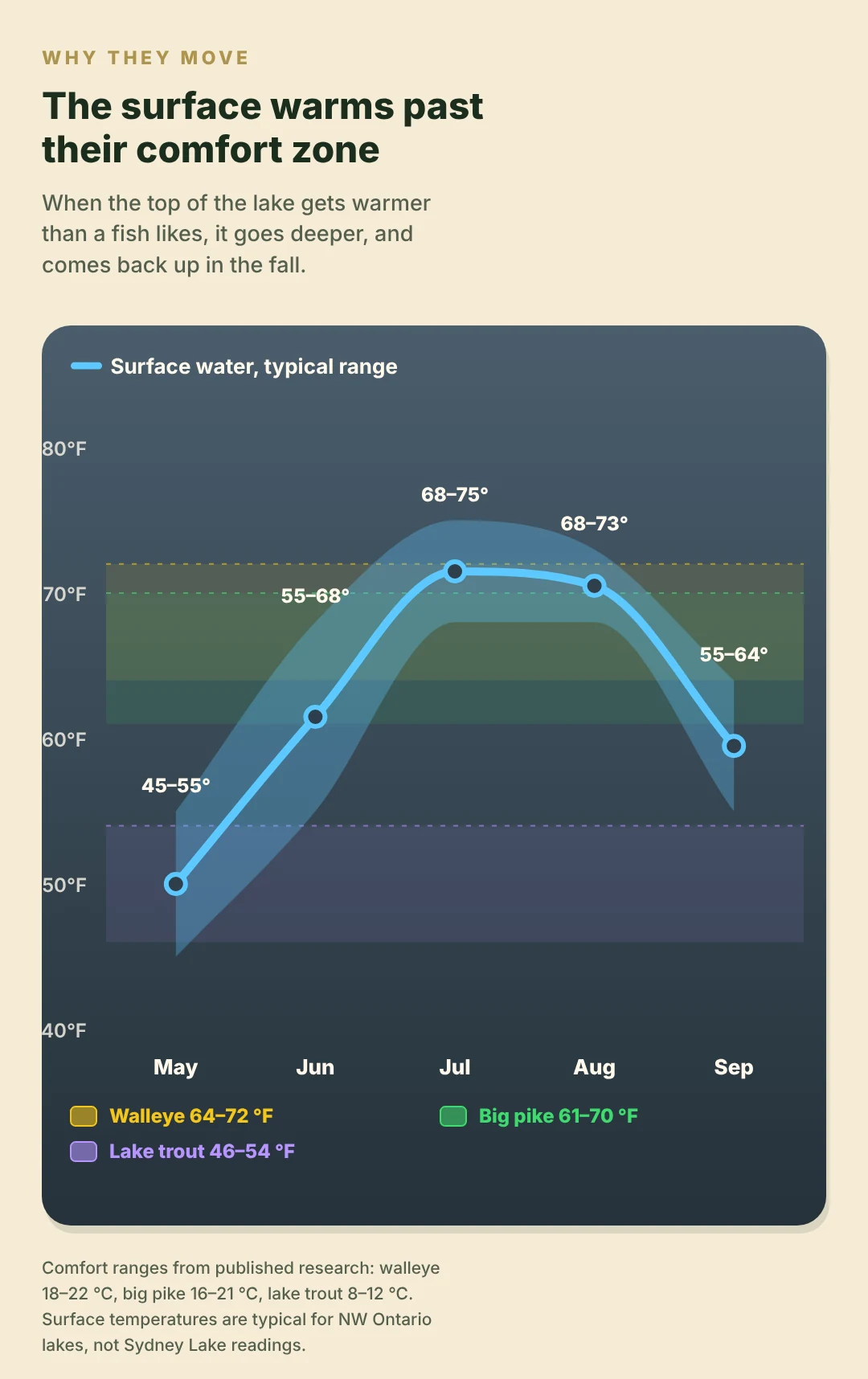
In numbers: typical surface water 45–55 °F in May, 55–68 °F in June, 68–75 °F in July, 68–73 °F in August and 55–64 °F in September. Comfort ranges from published research: walleye 64–72 °F (18–22 °C), big pike 61–70 °F (16–21 °C), lake trout 46–54 °F (8–12 °C).
Time of day
Time of day matters most for walleye, less for pike, and hardly at all for lake trout, which care more about depth.
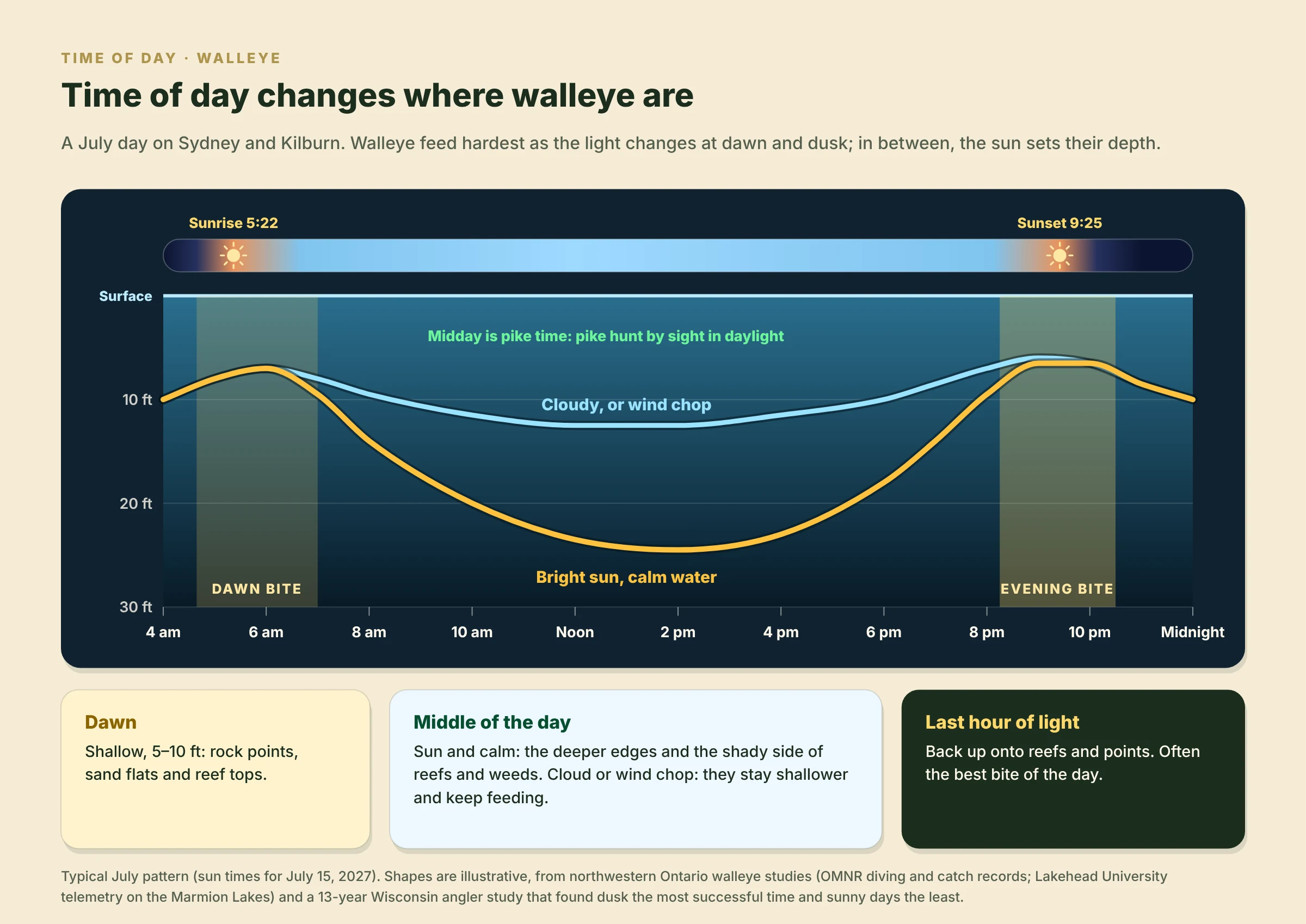
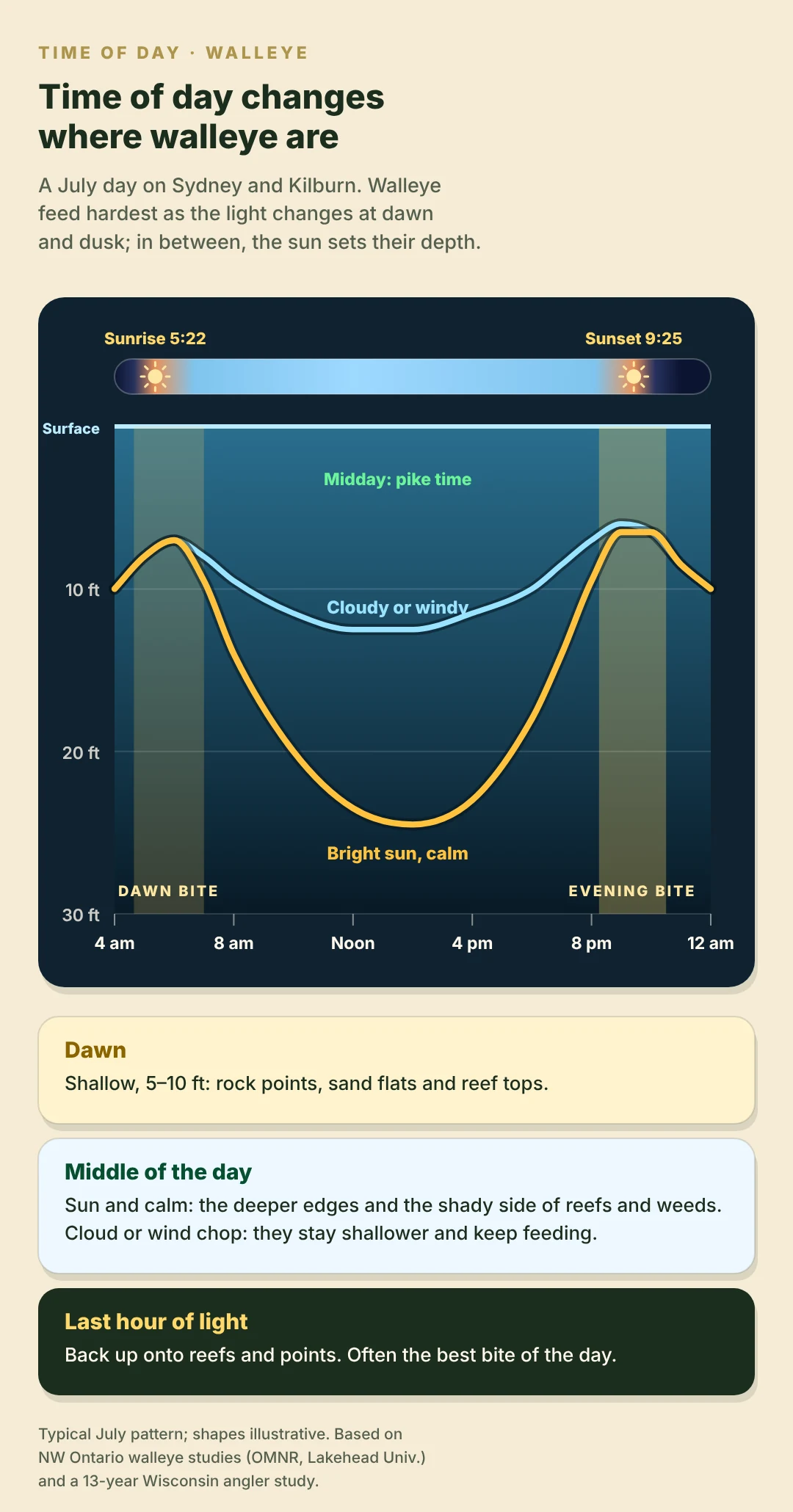
In numbers, for a typical mid-July day (sunrise 5:22 a.m., sunset 9:25 p.m.): walleye about 7–8 ft at dawn. On bright, calm days they are near 14 ft by 8 a.m., 20 ft by 10 a.m. and 23–25 ft from noon to 4 p.m.; on cloudy or windy days they stay near 12 ft through midday. Both are back to about 6–7 ft in the last hour of light.
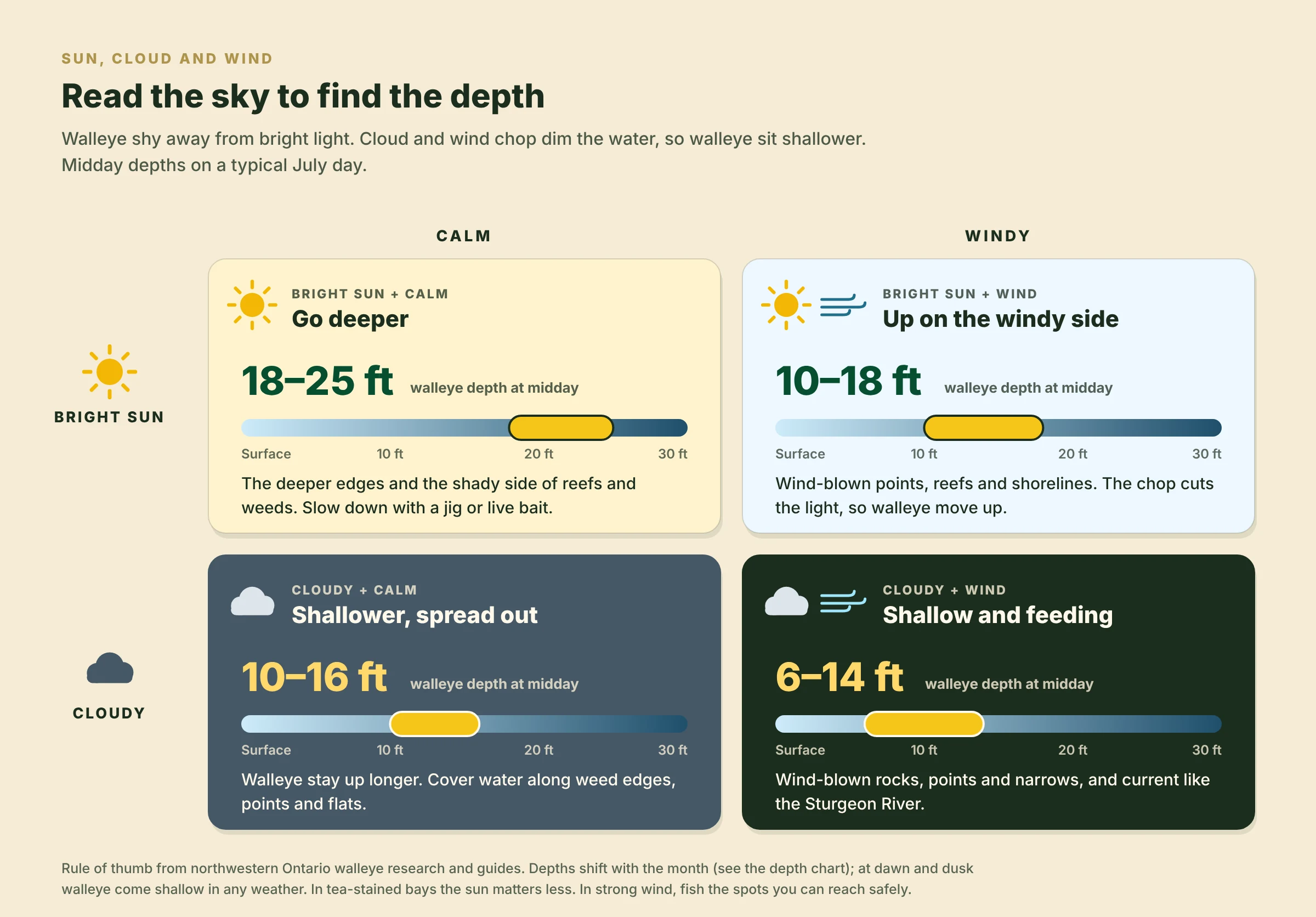
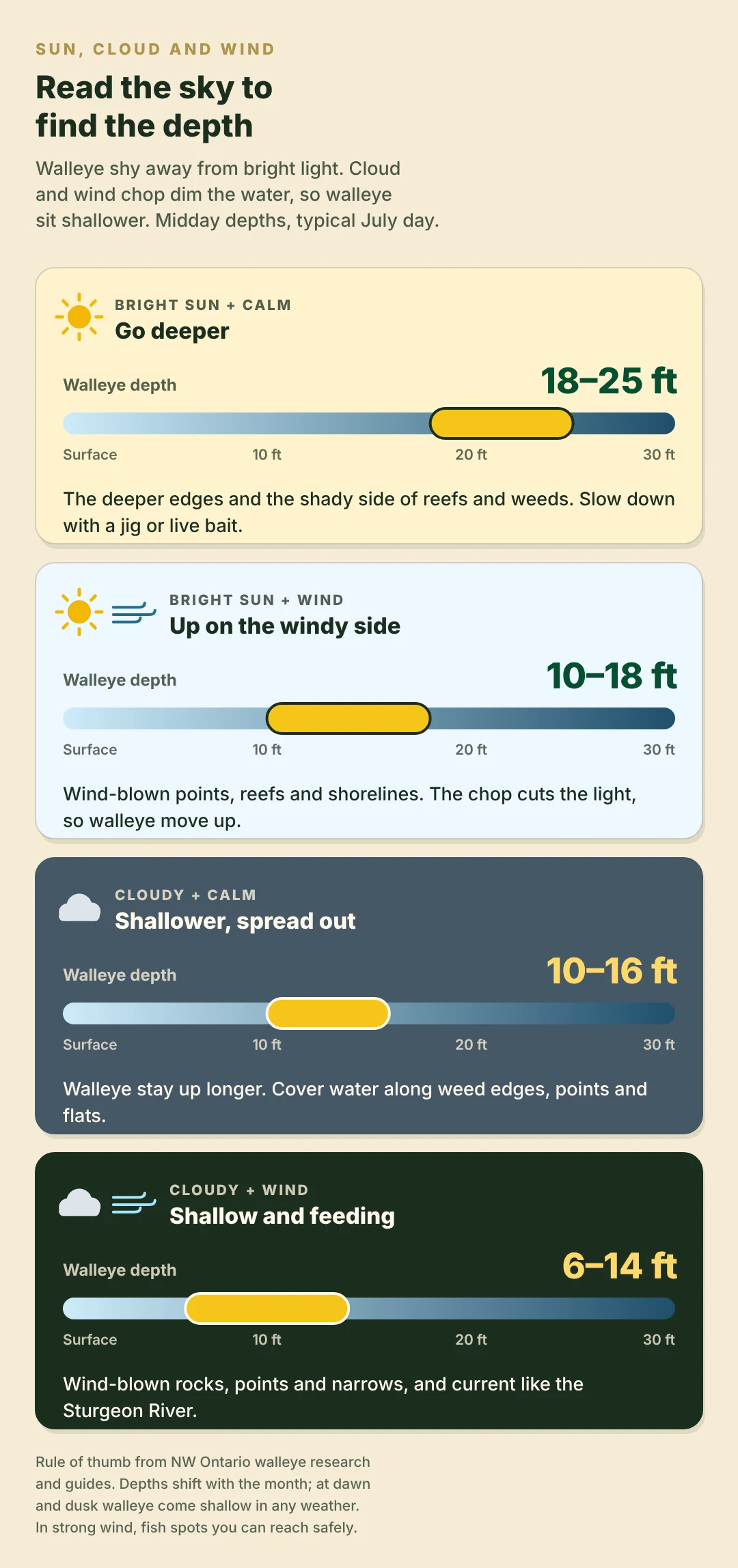
In numbers, walleye depth at midday in July: bright sun and calm, 18–25 ft; bright sun and wind, 10–18 ft on wind-blown spots; cloudy and calm, 10–16 ft; cloudy and windy, 6–14 ft.
Walleye
Dawn, dusk, cloud and chop
Walleye eyes are built for dim light, so in bright sun they hold deeper and move up to feed at dawn and dusk. In Sydney’s clear water, low light, cloud and a good walleye chop matter most. In Kilburn’s tea-stained water the midday bite can be just as good.
Try: mornings until about 1 p.m. and evenings after 5.
Northern pike
Midday sun is fine
Pike hunt by sight and bite all day, sun or cloud. At midday, fish a little deeper on the same points and weed edges. Calm summer evenings are for topwater.
Try: a spoon over the weed edges at noon.
Lake trout
Find 46–54 °F water
Get to the right depth in summer and midday jigging works as well as dawn. When they’re shallow in May and late September, the first hours are best, but they bite all day.
Try: a depth finder before a clock.
June and July
Fishing light until after 10 p.m.
Near the longest day the sun sets about 9:35 p.m., with fishing light until about 10:20. Many groups fish the morning, rest in the heat of the day and go back out after supper.
Try: a nap at 2 p.m. and a jig at 8.
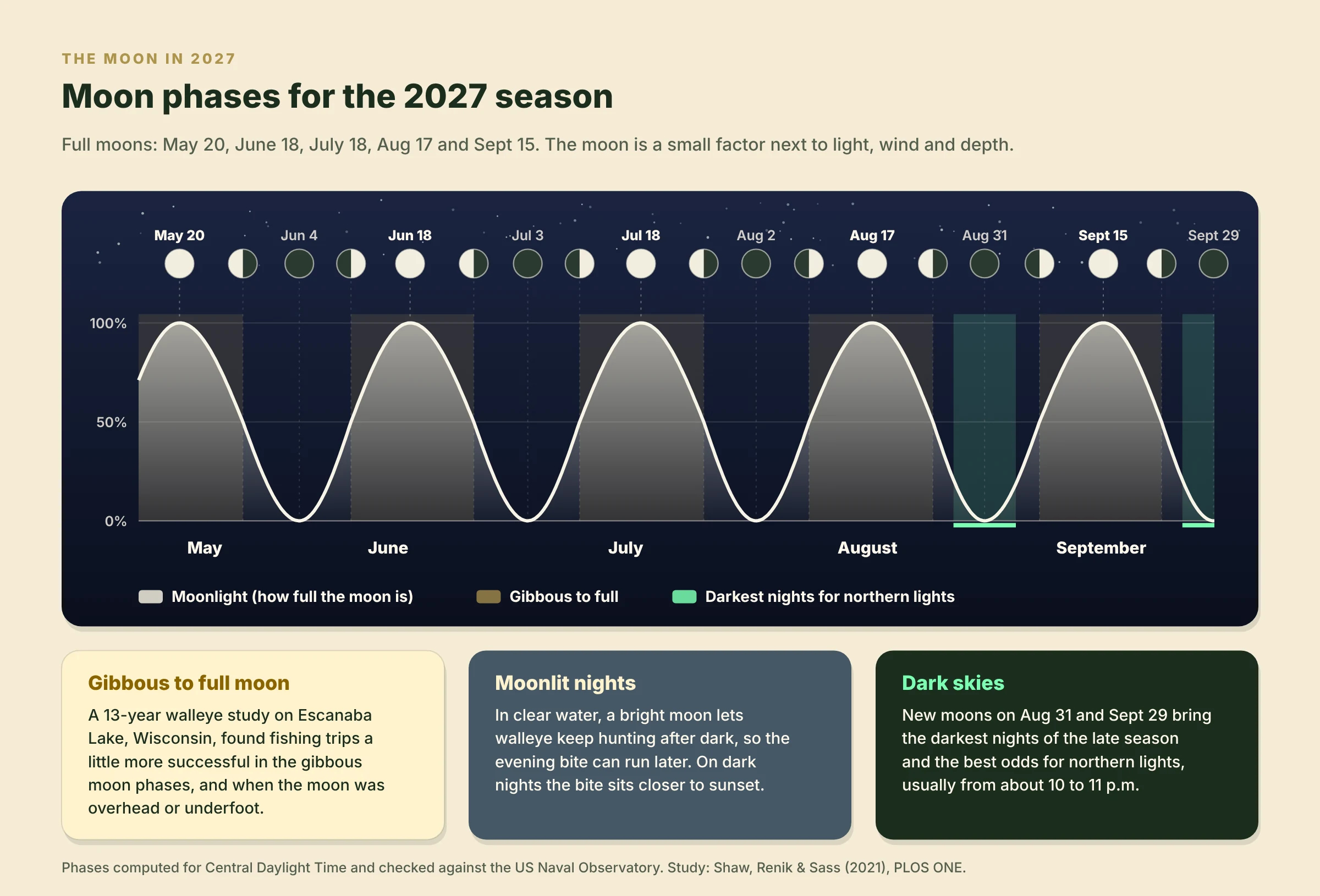
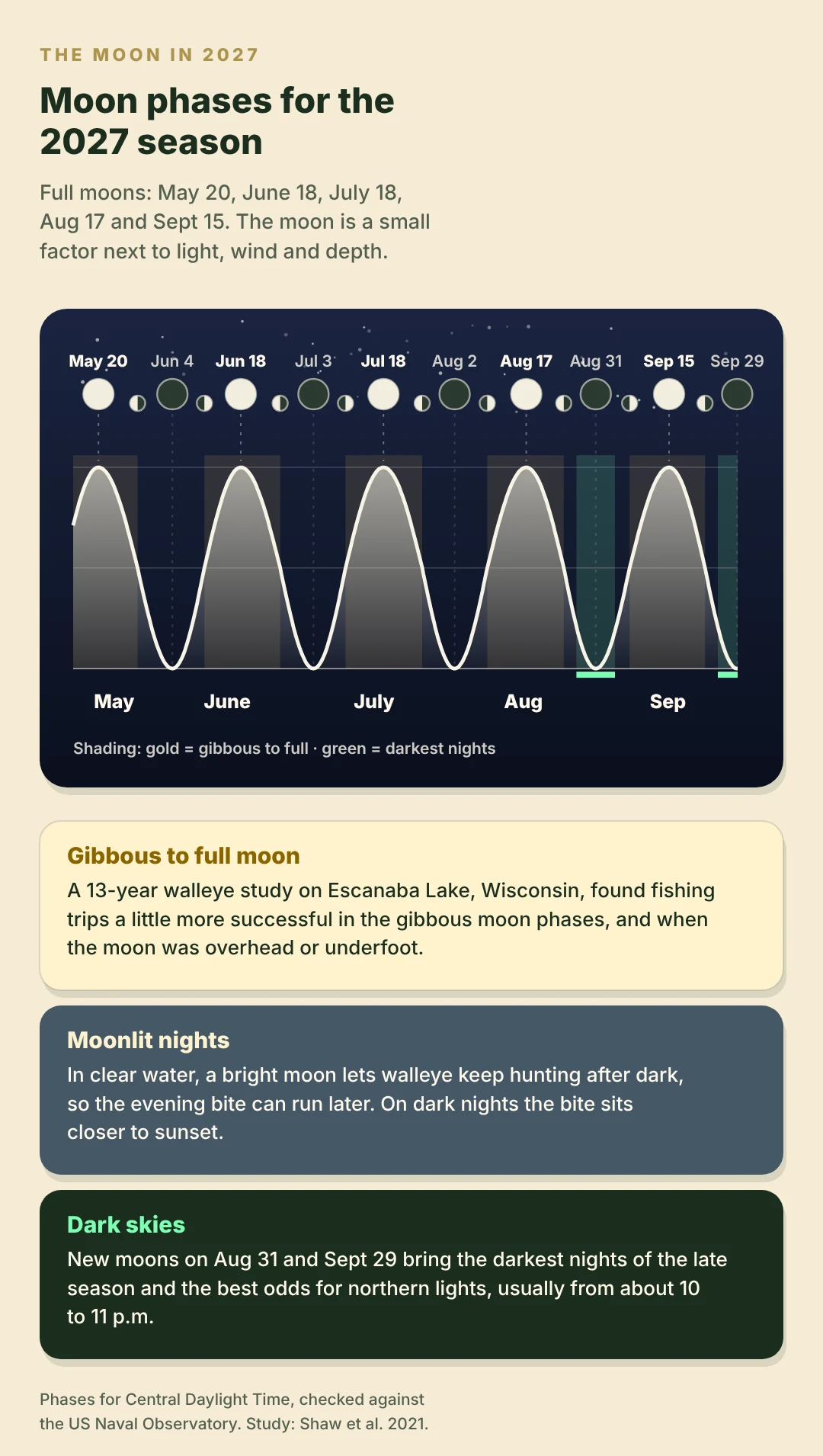
In numbers, 2027 (Central Daylight Time): new moons May 6, June 4, July 3, August 2, August 31 and September 29; full moons May 20, June 18, July 18, August 17 and September 15.
Where the fish are
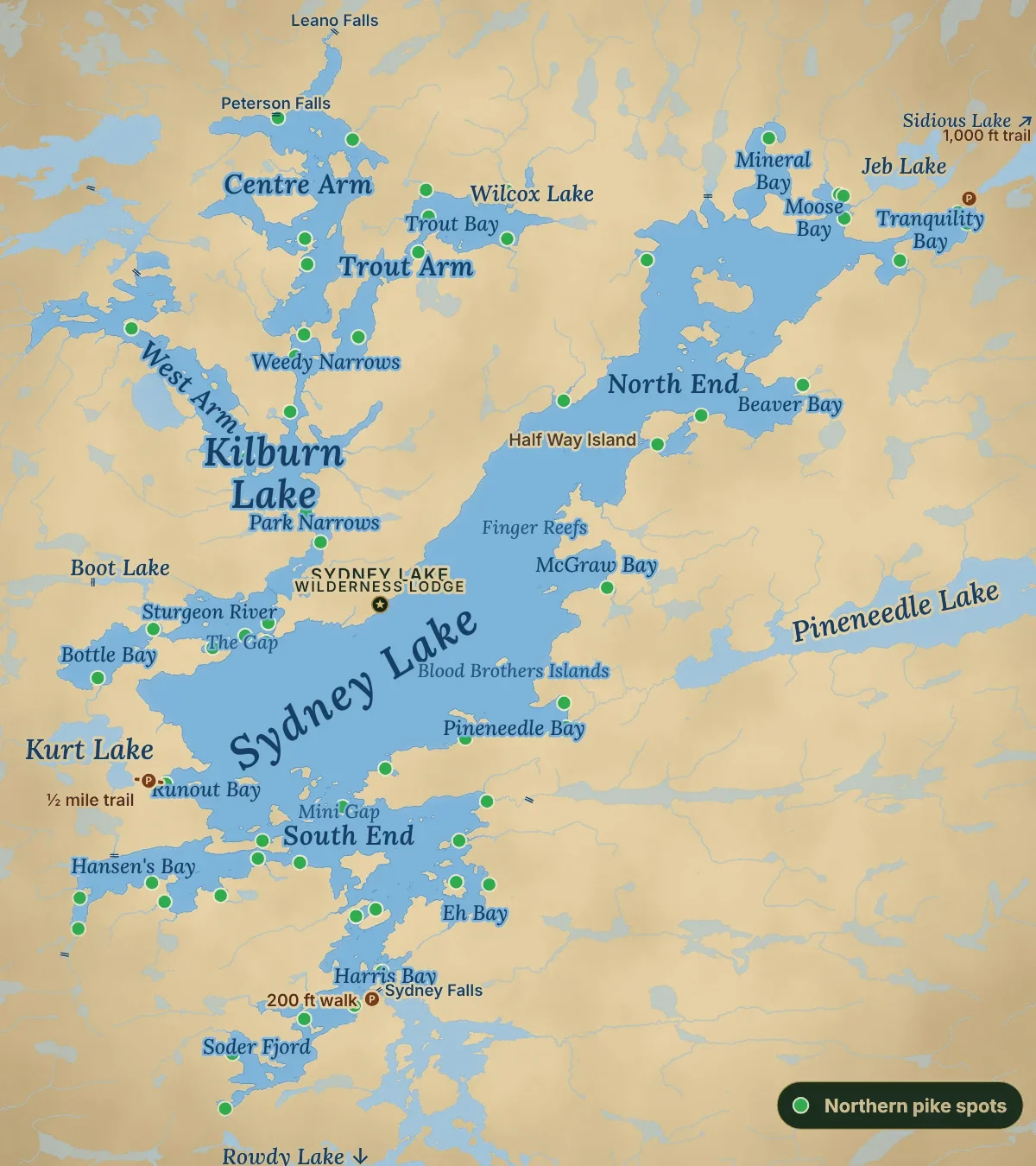
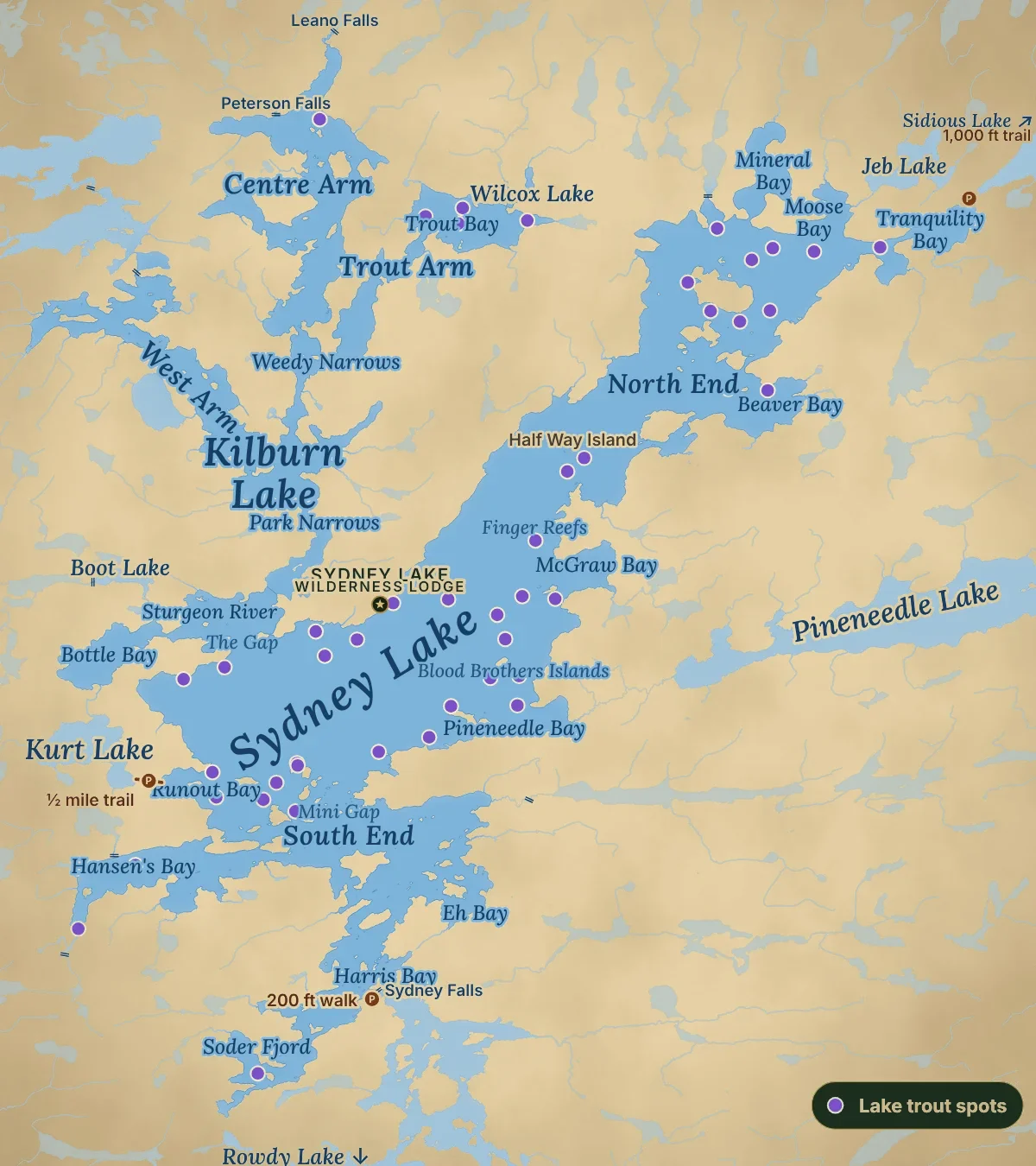
Tap a map to open it with that layer of spots turned on. Every group also gets a waterproof lake map, and we’ll mark what’s working that week when you arrive.
Beyond the fishing
The fishing is good all season, so the rest of the trip often decides your week. Each season has its own page with the weather, bugs, wildlife and life at camp.
Mid May to early July
Shallow walleye and the longest days
The walleye opener (May 15 in 2027), black bears on the spawning creeks, the mayfly hatch and about 16½ hours of daylight in June. Blackflies run from late May to mid-June.
July and August
Warm water, moose and blueberries
Average highs in the mid-70s °F, with plenty of days in the 80s and the odd one near 100, so every cabin is air-conditioned. Water warm enough to swim, moose in the bays at dusk, wild blueberries from late July and the northern lights back from mid-August. Mosquitoes at dawn and dusk; far fewer bugs by mid-August.
September
Heaviest fish, almost no bugs
Frosty mornings and warm afternoons, lake trout on the shoals, fall colours in the last two weeks, and long, dark nights for the northern lights.
Questions
For a fly-in trip in northwestern Ontario, any week from the walleye opener in mid May to the end of September. The fish don’t leave, they move: walleye are in the shallow bays in May and June, on deeper structure in July and August, and deeper still in September, when the lake trout come up onto the rocky shoals. For a trophy, late August and September give you the heaviest fish.
It depends what you want. For the most walleye, late May and June, when they are shallow, bunched up and hungry after the spawn. For the biggest walleye, September, when they are heaviest after a summer of feeding; our biggest walleye of 2025 came in September. July and August are good too, once you follow the walleye out to main-lake points, reefs and humps in 10 to 30 feet.
In northwestern Ontario the walleye season opens the third Saturday in May (May 15 in 2027), and a fly-in trip is good any week from then to the end of September. Choose by what you want most: shallow, easy fishing in late May and June, warm weather and family time in July and August, or trophy fish, fall colours and almost no bugs in September.
In Zone 2, where Sydney Lake is, walleye season opens the third Saturday in May: Saturday, May 15, 2027. Our camp opens the Friday before. Check the current Ontario regulations before your trip.
Low light: early morning, evening, and cloudy or windy days. In Sydney’s clear water walleye feed shallow at dawn and dusk; in Kilburn’s tea-stained water and on windy days, midday can be just as good.
Late August and September, after a summer of feeding and as the fish start building eggs for the next spawn. In 2025, our biggest walleye, northern pike and lake trout were all caught in September.
In Zone 2, where Sydney Lake is, lake trout season closes September 30, which is why our season ends then. Walleye and northern pike stay open past our season. The Sydney Lake area has its own limits for non-Canadian anglers, so check the current regulations.
Warm to hot. Highs average about 76 °F (24 °C), but many days reach the 80s and once in a while it touches 100 °F; every cabin has air conditioning. Walleye move from the bays out to points and reefs in 10 to 25 feet, big pike look for cooler water near deep edges, and lake trout go deep.
Pick your week
Tell me when you’d like to come and how many are in your group, and I’ll let you know what’s open and where the fish are likely to be that week. Every week from the opener to September 30 fishes well, and late August and September bring the heaviest fish.
More fishing: Walleye · Northern pike · Lake trout · Ontario fishing · Check dates