How to catch walleye · Mid-May to September

How to Catch Walleye: A Month-by-Month Guide

Where walleye are each month, how deep, what to throw and when to go, in plain English. It’s how we fish Sydney and Kilburn, and it works on most Canadian Shield lakes. — Jeb

A walleye held up over open water on Sydney Lake, Ontario

Start here

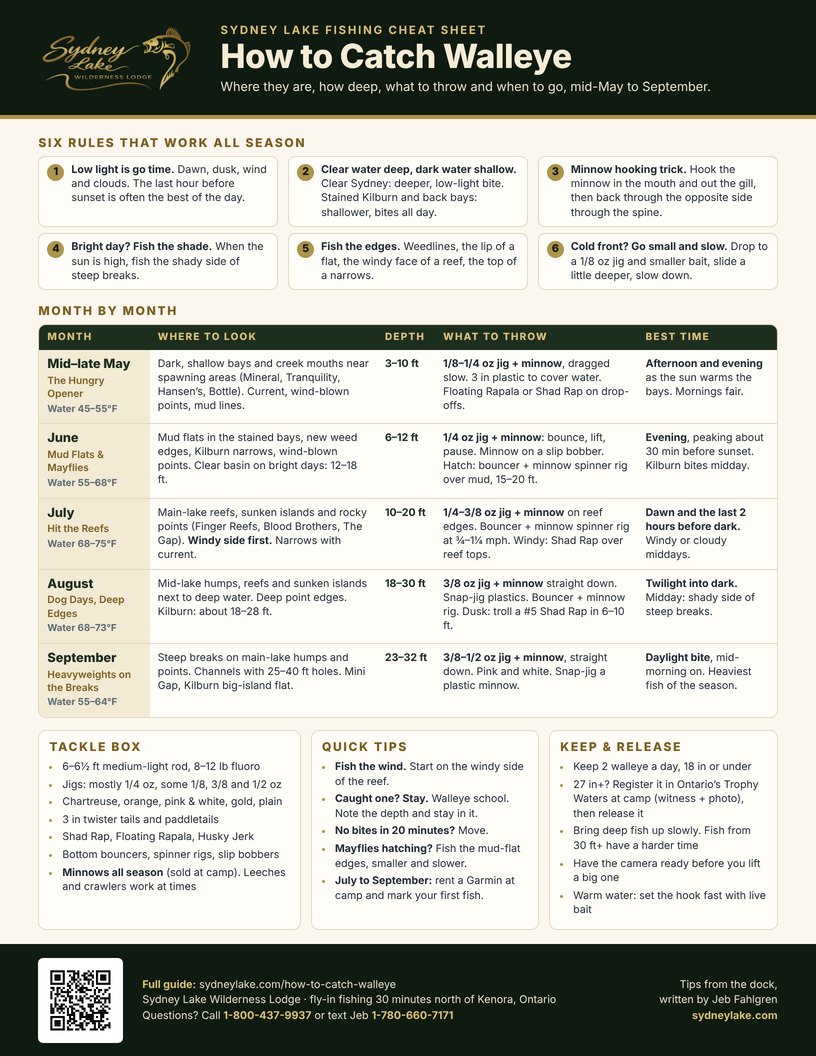
Six Walleye Rules That Work All Season

Learn these six and you’ll catch walleye in any month. The monthly game plans below build on them.

1

Low light is go time

Walleye see far better than their prey in dim light. Dawn, dusk, wind and clouds are your friends, and the last hour before sunset is often the best of the day.

2

Clear water deep, dark water shallow

In Sydney’s clear main lake, walleye sit deeper and bite best at low light. In tea-stained Kilburn and the back bays, they stay shallow and bite more of the day.

3

Minnow hooking trick

Hook the minnow in the mouth and out the gill, then back through the opposite side through the spine, so it stays put on the jig.

4

Bright day? Fish the shade

When the sun is high, fish the shady side of steep breaks. Walleye avoid bright light and slide into the shade of the drop.

5

Fish the edges

Walleye hold where two things meet: the edge of a weedline, the lip where a flat drops off, the upwind face of a reef, the top of a narrows.

6

Cold front? Go small and slow

After a front blows through, drop to a 1/8 oz jig and a smaller bait, slide a little deeper, and slow everything down.

Month by month

Where Walleye Are, Month by Month

Pick your month for the game plan: where to look, how deep, what to throw and when to go.

DEPTH (FEET) →Most fishSome fish / big fish010203040May3–10 ftJune6–12 ftJuly10–20 ftAugust18–30 ftSeptember23–32 ft

Depths are where most walleye sit on Sydney Lake. Kilburn’s darker water can run shallower early in the summer, and by August its walleye sit about 18–28 ft. The biggest fish often sit a little deeper than the pack.

Mid–late May · Water 45–55°F

The Hungry Opener

Walleye just finished spawning and they’re starving. They sit shallow, close to where they spawned, and once the water hits 50°F they’ll eat a slow jig all day.

Depth3–10 ft
WhereDark bays & creek mouths
Best timeAfternoon & evening
Go-to lureJig + minnow

Where to look

  • Creek mouths, narrows and bays with a little current
  • Dark, shallow bays that warm up first: Mineral, Tranquility, Hansen’s and Bottle Bay
  • Wind-blown points and mud lines where waves stir up the bottom
  • Shallow flats right next to deeper water

What to throw

  • 1/8–1/4 oz jig + live minnow. Drag it slowly along the bottom. Slower than you think.
  • 3 in twister or paddletail on a 1/4 oz jig to cover water fast
  • Shallow crankbait (Original Floating Rapala, Shad Rap) where the shallows drop off
  • Live minnows are sold at camp

When to go

  • 🌅 Morning: Fair. Start on wind-blown points.
  • ☀️ Afternoon: Often the best. The sun warms the dark bays and walleye pile in.
  • 🌙 Evening: Prime time in the bays as fish push shallow to feed.

Jeb’s play

Find 50°F water. Fish the warmest dark bay you can find, and fish it shallower than you expect. The main lake can wait till summer.

June · Water 55–68°F

Mud Flats and Mayflies

Walleye spread out over the mud flats in the tea-stained bays and feed hard. Late in the month the mayflies hatch, the fish gorge, and you have to slow way down.

Depth6–12 ft
WhereMud flats & new weeds
Best timeEvening
Go-to lureJig + minnow

Where to look

  • Mud flats in the tea-stained bays: Mineral, Tranquility, Hansen’s and Bottle
  • Kilburn’s narrows and anywhere with current
  • Edges of the new green weeds
  • Wind-blown points and reef tops
  • Clear main basin on bright days? Try 12–18 ft.

What to throw

  • 1/4 oz jig + minnow. Bounce it, lift 1–2 in, pause.
  • Minnow on a slip bobber, 12–16 in off the bottom
  • During the hatch: bottom bouncer (1 oz for every 10 ft of water) with a minnow on a spinner rig, dragged over mud flats in 15–20 ft. Leeches or a crawler harness can work well here too.

When to go

  • 🌅 Morning: Good till about 10 am, then it slows in clear water.
  • ☀️ Afternoon: Head to the stained bays or a windy point. Kilburn fishes well even in bright sun.
  • 🌙 Evening: Best of the day. The bite peaks about 30 minutes before sunset, and it stays light past 10 pm.

Jeb’s play

When the mayflies are popping, don’t panic. The walleye are full, not gone. Slide out to the edge of the mud flat, go smaller and slower, and keep your bait right in their face.

July · Water 68–75°F

Hit the Reefs

Walleye move out to main-lake structure: reefs, sunken islands and rocky points. The wind is your best friend this month.

Depth10–20 ft
WhereReefs & sunken islands
Best timeDawn, dusk & windy days
Go-to lureJig + minnow

Where to look

  • Main-lake reefs, sunken islands and rocky points like the Finger Reefs, Blood Brothers and The Gap
  • The windy side and front edge of every reef and point
  • Narrows with current. Kilburn’s narrows stay good all July.
  • Edges of the mud flats after the hatch

What to throw

  • 1/4–3/8 oz jig + minnow on the reef edges
  • Bottom bouncer (1.5–2 oz) + minnow on a spinner rig on a 3–4 ft leader at ¾–1¼ mph
  • Minnow on a slip bobber over the reef tops. A leech or crawler can be hot some days too.
  • Hot, windy day? Cast a Shad Rap or jerkbait over reef tops in 3–10 ft for the big females.

When to go

  • 🌅 Morning: Strong from first light to about 10 am.
  • ☀️ Afternoon: Fish windy or cloudy reefs, the shady side of steep breaks, or run to Kilburn, where the darker water bites all day.
  • 🌙 Evening: The last hour or two before dark is the best bite on clear Sydney.

Jeb’s play

Fish the wind. Pick the reef the wind is blowing into and start on the windy side. That’s where the baitfish get pushed, and that’s where the biggest walleye feed.

August · Water 68–73°F

Dog Days, Deep Edges

Walleye go deeper and school up on mid-lake humps. Find one and you’ve usually found a bunch.

Depth18–30 ft
WhereHumps & deep edges
Best timeEvening into dark
Go-to lure3/8 oz jig + minnow

Where to look

  • Mid-lake humps, reefs and sunken islands close to deep water
  • Deep edges of main-lake points
  • On Kilburn, walleye sit about 18–28 ft

What to throw

  • 3/8 oz jig + minnow straight down under the boat
  • Snap-jig a plastic for hungry schools: rip it up 2–3 ft, let it fall
  • Bottom bouncer (about 2 oz) + minnow on a spinner rig at 1 mph or slower
  • At dusk: troll a #5 Shad Rap or #11 Rapala along shore in 6–10 ft, 50–75 ft behind the boat, at 1.5–1.8 mph

When to go

  • 🌅 Morning: Good early on the humps.
  • ☀️ Afternoon: The toughest bite of the year in clear water. Fish the shady side of steep breaks, go deeper, or go to Kilburn.
  • 🌙 Evening: Twilight into dark is the strongest bite of the month.

Jeb’s play

Don’t fish your June spots. Rent a Garmin at camp, cruise the humps till you see fish, and drop a marker on your first walleye. Where there’s one, there’s a school.

September · Water 55–64°F

Heavyweights on the Breaks

The water cools, walleye stack up on steep breaks, and they’re the heaviest of the season. Our biggest walleye of 2025, a 31 in fish, came in September.

Depth23–32 ft
WhereSteep breaks & channels
Best timeMid-morning on
Go-to lure3/8–1/2 oz jig + minnow

Where to look

  • Steep breaks on main-lake humps and points
  • Narrow channels between islands with 25–40 ft holes
  • Mini Gap, and Kilburn’s big-island flat in 22–26 ft

What to throw

  • 3/8–1/2 oz jig + minnow, straight down on 8 lb fluoro.
  • Pink-and-white is a September favourite
  • Snap-jig a plastic minnow: lift 2–3 ft, let it free-fall
  • Swimbait worked along the break for the big ones

When to go

  • 🌅 Morning: Good, and worth the cold boat ride. Bundle up.
  • ☀️ Afternoon: Deep walleye bite in daylight. Mid-morning into the afternoon is steady.
  • 🌙 Evening: Still good, but the days are short. Plan to be back at the dock before dark.

Jeb’s play

Find the depth band and stay in it. If you catch one at 27 ft, the rest are at 27 ft too. Use the troll control to hold the boat right on top of them.

Tackle

Your Walleye Tackle Box

Walleye fishing is simple. One small box covers the whole season. See the full packing and tackle list.

Rod, line & rigs

  • 6–6½ ft medium-light spinning rod
  • 8–12 lb line. Fluorocarbon is best.
  • Bottom bouncers (1–2 oz) and spinner rigs
  • Slip bobbers and a few split shot

Jigs & plastics

  • Mostly 1/4 oz jigs, plus some 1/8, 3/8 and 1/2 oz for deeper water or windy days
  • Colours: chartreuse, orange, pink & white, gold and plain
  • 3 in twister tails and paddletails

Crankbaits & bait

  • Shad Rap, Original Floating Rapala and Husky Jerk
  • Minnows are the go-to bait all season, and we sell them at camp
  • Leeches and crawlers work well at times, but leeches are hard to find and crawlers make a mess of the boat. If you want some, try a bait shop in Kenora. You can’t bring live bait across the border.
  • Rent a Garmin depth finder at camp for July to September

Myths and mistakes

Walleye Mistakes to Skip

✕

“Colour is the secret”

The right spot, depth and speed matter way more. Pick a colour for the water clarity and move on.

✕

“There’s no midday bite”

Not in stained water, on windy reefs or in current. Kilburn bites all day.

✕

“Summer walleye all go deep”

Some of the biggest feed on wind-blown reef tops in just a few feet of water.

✕

“The mayfly hatch ruins it”

The fish are full, not gone. Fish the mud-flat edges and slow down.

✕

“Live bait always wins”

Plastics often beat bait on aggressive late-summer schools. Bait shines after a cold front and on fussy fish.

✕

Waiting on a dead spot

Walleye travel in schools. No bites in 20 minutes? Move till you find them, then slow down and stay.

Keep and release

Keep a Couple for Shore Lunch. Let the Big Ones Go.

The rules at camp

  • Keep 2 walleye a day, 18 in or under. They’re the best eating anyway.
  • Walleye 27 in or longer can be registered in Ontario’s Trophy Waters at camp with a witness and a photo, then released.

Releasing a big walleye

  • Have the camera ready before you lift the fish, and get it back in fast.
  • Hold it level and support the belly.
  • Walleye pulled up from deeper than about 30 ft have a harder time after release. Bring deep fish up slowly, and keep a deep one as your eater.
  • In warm water, set the hook fast with live bait so the fish doesn’t swallow it.
A released walleye swimming back into Sydney Lake

Keep reading

More Ways to Plan Your Fishing