Ontario’s Trophy Waters · Sydney Lake
Sydney Lake sits inside Ontario’s Trophy Waters, a government-backed conservation area of fly-in lakes in Northwest Ontario where the biggest fish are released so they keep growing. Here are the trophy sizes, how to register a fish, and the Sydney Lake anglers who have won the free trip.


Steve Wilhelm’s 46-inch pike, the 2023 Trophy Waters winner
38″
trophy northern pike
38 inches or longer, released alive.
27″
trophy walleye
27 inches or longer, caught and released alive.
32″
trophy lake trout
32 inches or longer, released to go back to the depths.
Free trip
for each year’s biggest
The largest registered fish of each species wins a trip back the next season.
What it is
Ontario’s Trophy Waters is a conservation fishing area in Northwest Ontario. It grew out of an agreement between fly-in outfitters, the Ontario government, First Nations, forestry companies and local citizens’ groups to protect one of the province’s best remote fisheries. The idea is simple: keep a few smaller fish for dinner, and put the big ones back so there are trophies for your kids and grandkids.
The area runs from Sydney and Kilburn Lakes in the northeast, south to the English River and west to the Manitoba border, roughly 300,000 hectares of lakes and rivers. Most of it has no roads, so fishing pressure stays low and big fish get the chance to grow old. Six member outfitters operate here, and their guests register more than 2,000 trophy fish a season.
Ontario’s fishing regulations treat it as a special area, the “Sydney Lake Area” (North Kenora Pilot Project) in Zones 2 and 4, with lower daily limits for anglers from outside Canada: 2 walleye (only one over 18 inches), 2 northern pike (none between 27½ and 35½ inches, only one bigger), 1 lake trout, 1 bass and no muskie. We’ve fished conservation-first on Sydney since 1987, and every trophy our guests register goes into the Trophy Waters book.
Why these lakes grow big fish →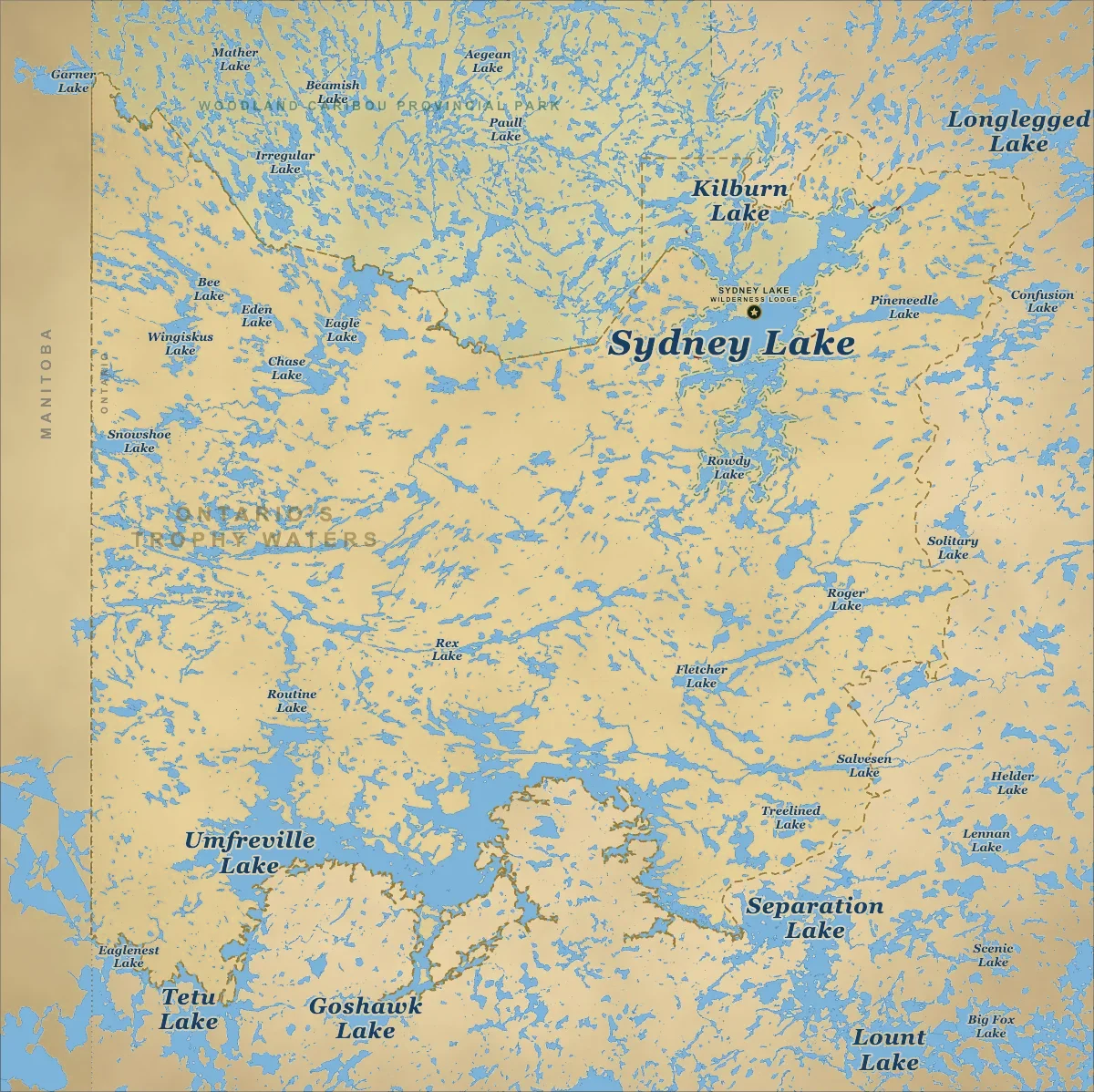
Where it is
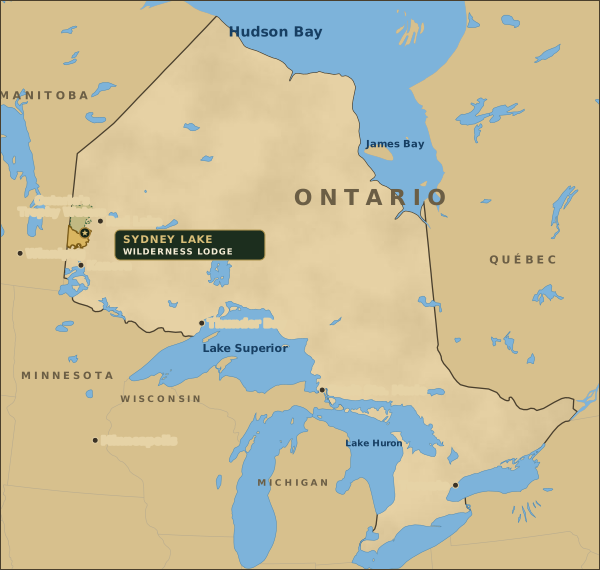
The Trophy Waters fills the country between the English River and Woodland Caribou Provincial Park, from the Manitoba border east to Separation Lake. Sydney and Kilburn Lakes are at its north end, where you see the star. Click the map to open the full-screen version: switch between map and satellite view, turn place names on or off, and click any lake to zoom in on it.
The lodge
The star on Sydney Lake. Kenora is 60 miles south, about 30 minutes by float plane.
Trophy Waters boundary
The gold dashed line, about 300,000 hectares from the English River north to Sydney Lake.
Woodland Caribou Park
The green area to the north. Sydney and Kilburn sit in both the park and the Trophy Waters.
Satellite view
Flip the switch to see the real forest, rock and water from space.
Trophy fishing
Sydney and Kilburn hold all three trophy species. Here’s what counts, and a few tips from decades of watching guests land them.
Trophy: 38 inches or longer
Several 42–46 inch pike every year
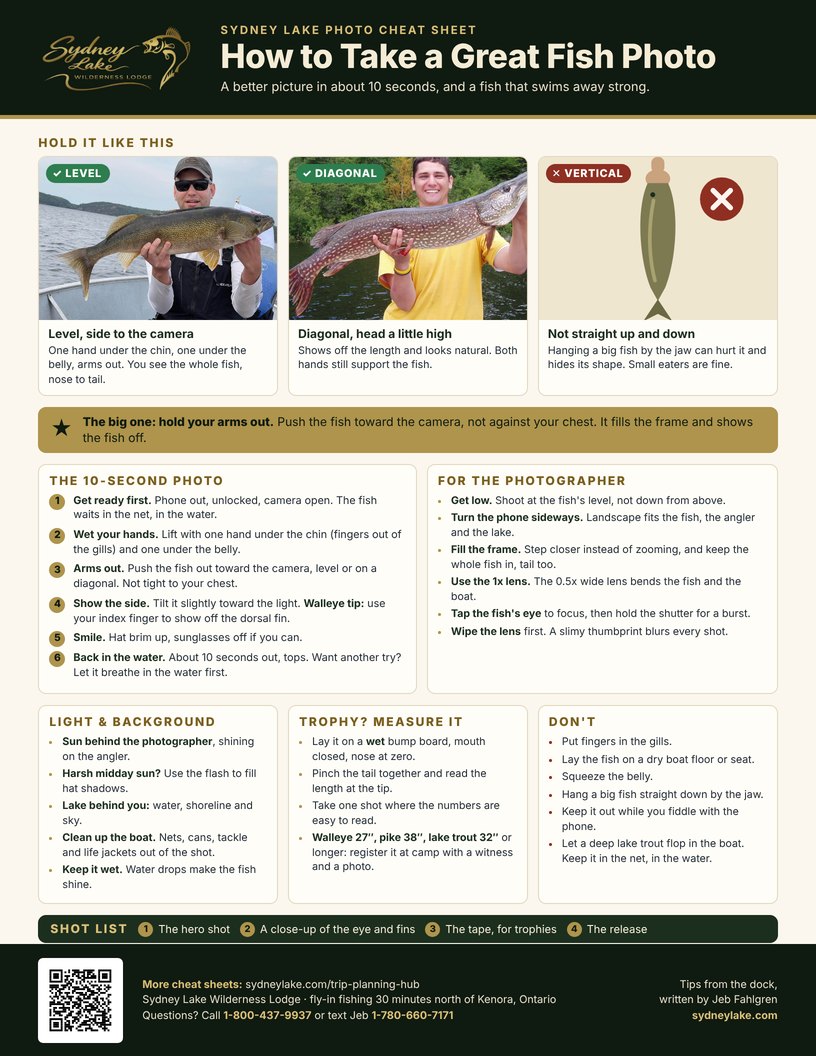
Big pike live in the weedy bays in spring and fall and slide out to deeper points and reefs in summer. A pike only counts as a Trophy Waters fish if it’s released alive, so get the photo and get it back in the water fast. Hold it horizontally with a hand under its belly; hanging a big pike vertically can injure it.
Try: big spoons and swimbaits on weed edges in June and September.
Trophy: 27 inches or longer
Most anglers’ best: 24–26 inches
For a 27-incher, fish near the bottom but not on it, and work around the edges of a school; the big ones usually hang toward one end. Big walleye feed later, so the last hour before dark in shallower water is prime time. Measure with the mouth closed, the tail pinched and the body straight.
Try: the same jigs you use for eaters, on 10–12 lb line.
Trophy: 32 inches or longer
Sydney’s basin is 240 feet deep
Lake trout are the heavyweights. They have soft mouths and often hit twice, so wait for the second strike and don’t set the hook too hard. Fish brought up from deep water need a quick release; once they’re back down they recover fine.
Try: shallow shorelines right after ice-out, then deep and slow from late June.
Every big fish
Time out of water matters most
Barbless single hooks release fastest and do the least damage. Skip jaw spreaders. If a fish swallows the hook, cut the line or clip the hook; it will work its way out. If a fish is slow to swim off, hold it by the tail, nose down at about 30 degrees, and move it gently back and forth until it kicks away.
Have the camera and tape ready before you net it.
Winners from Sydney Lake
The biggest registered fish of each species wins a free trip. Sydney Lake guests have taken the lake trout title six times since 2014, and the northern pike title in 2023 and 2024.
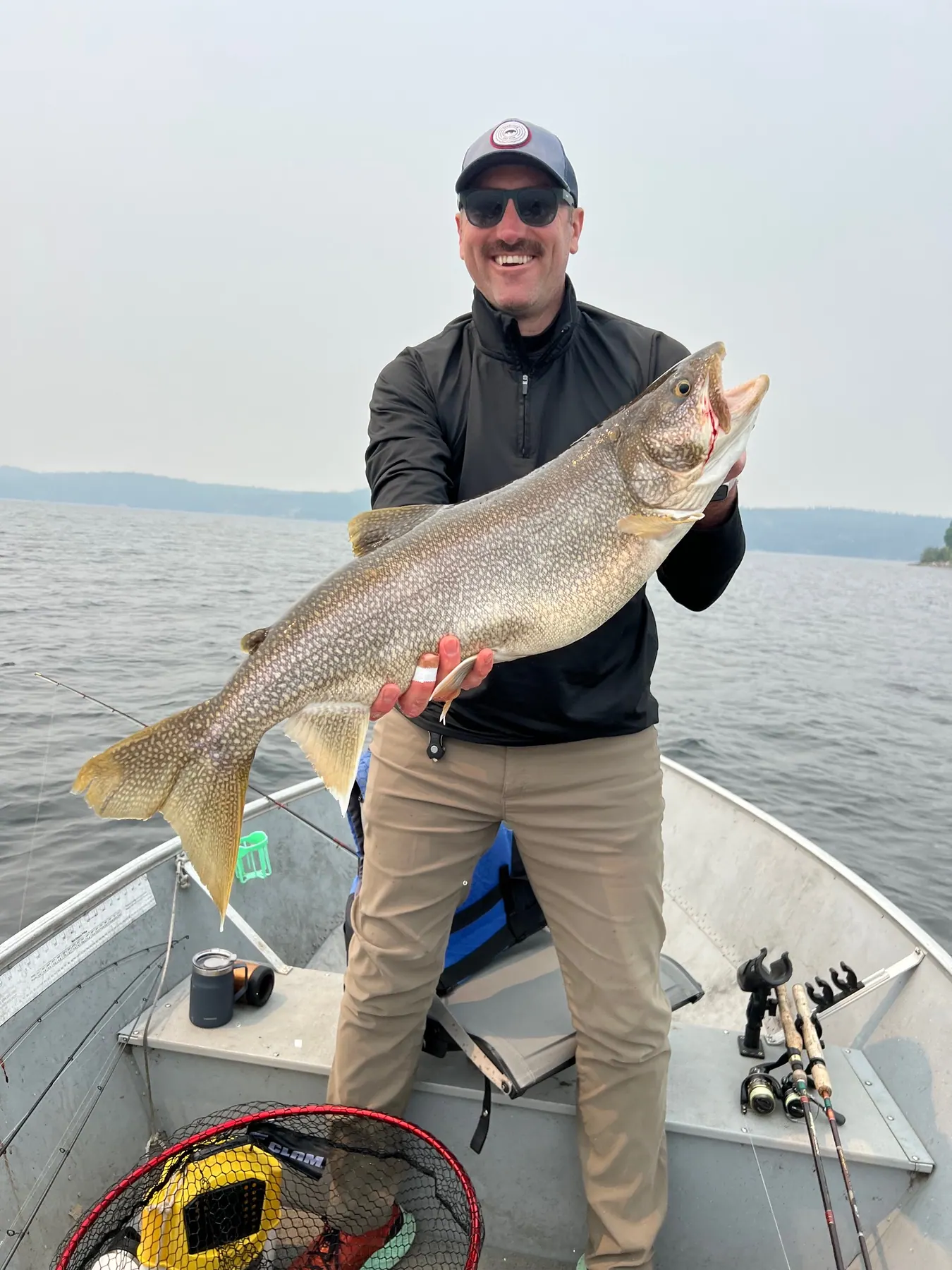
Lake trout · 2016
The biggest of our winning lake trout, caught and released on Sydney Lake.
Lake trout · 2025
Landed September 24, a week before lake trout season closed, and measured and released at the boat.
Northern pike · 2023 & 2024
Steve Wilhelm’s 46-inch pike won in 2023, and Rory H.’s 46-incher took the title again in 2024.
Lake trout · more winners
Todd Peterson, 39 inches (2014); Terry Davis, 38½ inches (2015); Glen Lefko, 38 inches (2017); Jon Edstrom, 33½ inches (2019).
Caught one?
It takes a minute in the boat and a few more back at the lodge. Your name goes in the Trophy Waters book, and you take home a Trophy Waters hat.
Step 1
Lay the fish flat on a measuring board or tape, mouth closed and tail pinched, and read the total length. Have your fishing partner watch; they’ll sign as your witness.
Step 2
Hold the fish horizontally, close to the water, and take a few shots fast. A clear picture is required for the free-trip prize, so make it a good one.
Step 3
Only fish released alive count. Ease it back into the water and hold it upright until it swims off on its own.
Step 4
We fill out the registration book with your details and your witness’s signature. If yours is the biggest of its species in the Trophy Waters that season, you win a free trip for the same package back at Sydney Lake the next year.
Your turn
Sydney and Kilburn are fly-in only, inside Woodland Caribou Provincial Park, with one lodge and 17,570 acres of water. Walleye are the main reason most guests come, and every trip has a real shot at a fish for the Trophy Waters book. Tell me when you’d like to come and I’ll let you know what’s open.
Check dates →Explore more: Trophy northern pike · Walleye · Lake trout · Woodland Caribou Park · Licences & limits