Golden walleye · Sydney Lake, Northwest Ontario
Walleye are the main course here: lots of them, and bigger than average. Every so often one comes up solid gold. You can’t book a golden walleye, and most trips won’t see one. When one does show up, it’s the story of the week.
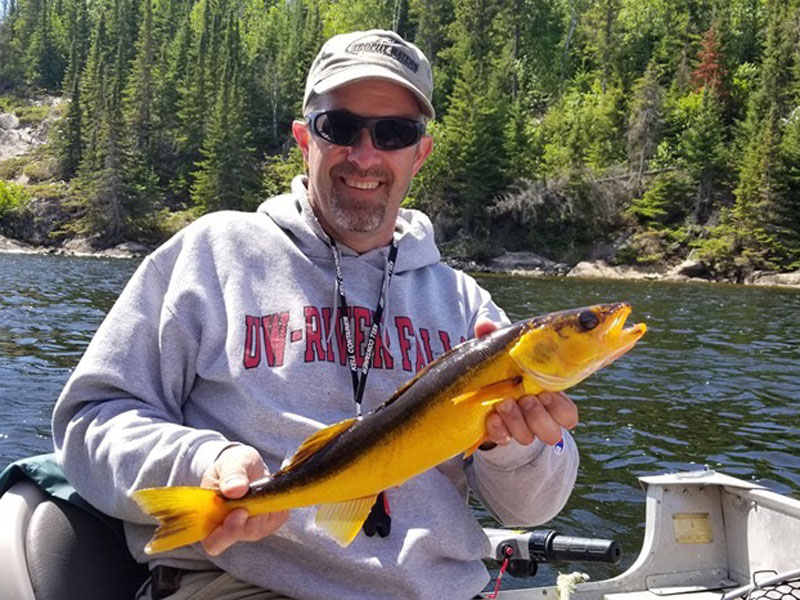
Craig Orf’s rare all-gold walleye · Sydney Lake
1930s
Golden walleye on Sydney
My great-grandfather found Sydney Lake, and its rare golden walleye, in the 1930s.
2024
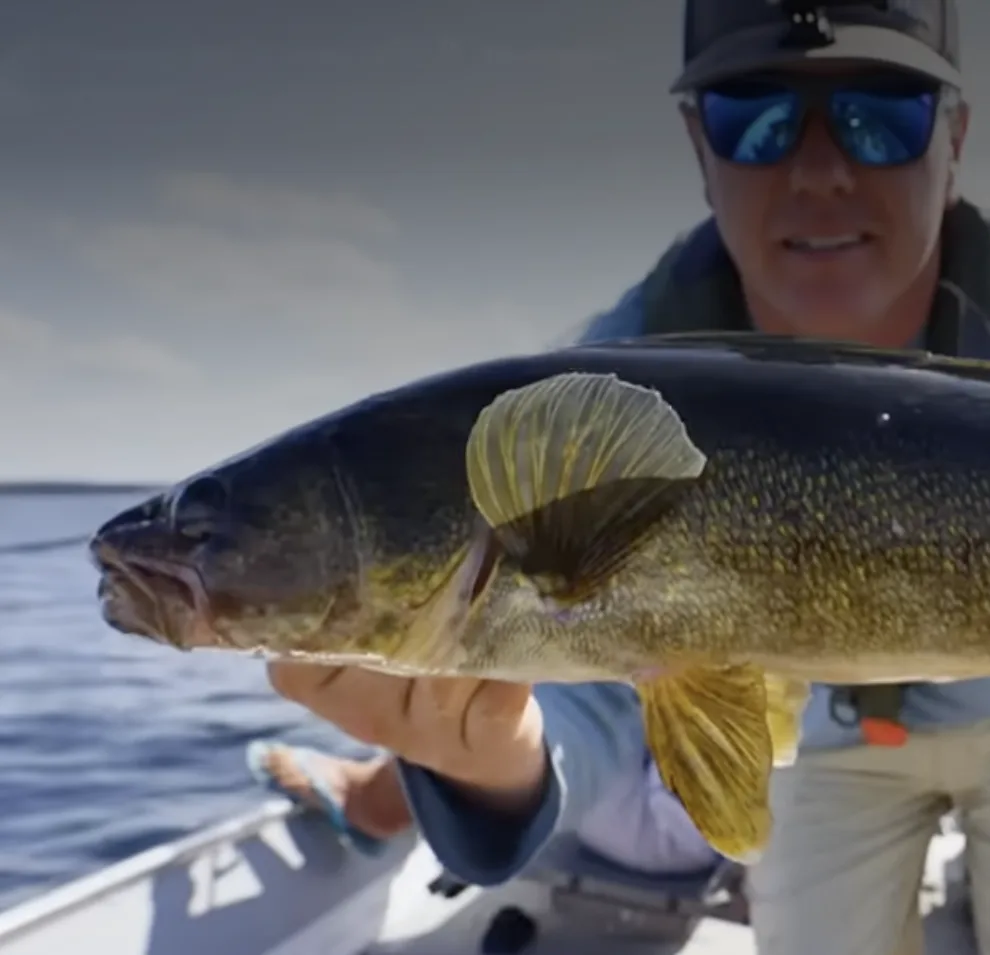
Jay Siemens’ gold walleye video
Filmed here on Sydney Lake. Watch it just below.
17,570
acres of water
Sydney, the Sturgeon River and Kilburn: 120 islands, about 190 miles of shoreline, one lodge.
1987
Catch and release since
Big walleye go back in the lake. No stocking, ever.
Watch: the gold walleye hunt
In 2024 fishing YouTuber Jay Siemens brought his cameras to Sydney Lake to hunt for a golden walleye. Guests started booking trips from that video before it was ever on our website. Press play to see the lake, the fishing and how his search turned out. We’re planning to have Jay back in 2028.
Check dates →More fishing on Sydney Lake: Trophy northern pike · Lake trout

What it is
Every walleye has some gold in it. Fisheries agencies describe the normal colour as anything from dark olive-brown to yellowish gold, with brassy flecks on the sides and a white tip on the lower lobe of the tail. Wisconsin’s DNR notes that walleye colour varies a lot with the clarity and colour of the water they live in.
A true golden walleye is something else. Most of the dark olive is missing, and the fish is yellow from nose to tail. Biologists call this xanthochromism, or xanthism: a rare, natural condition where a fish loses its darker pigment and the yellow shows through. It isn’t a separate species or a hybrid. It’s a walleye, just without the dark.
In the 1930s my great-grandfather flew across Northern Ontario looking for the best walleye fishing in Canada. He found Sydney Lake and its rare golden walleye, and that’s where our family’s story on the lake begins. Every so often, one still comes up solid gold.
The walleye pictured here is a normal Sydney Lake walleye with a rich gold tone. The fish at the top of this page is the rare, all-gold kind.
Why these lakes →Gold, olive or blue
Walleye come in more colours than most people expect. Here’s how to tell what you’re holding.
Most walleye
Dark back, brassy sides, white tail tip
The everyday walleye runs from dark olive-brown to yellowish gold, with a darker back, brassy flecks on the sides and a white tip on the lower tail. That white tip is the quickest way to tell a walleye from a sauger.
Look for: the white tip on the lower tail.
Tea-stained water
Colour follows the water
Walleye colour shifts with the clarity and tint of the water. In darker, tea-stained water like Kilburn Lake’s, walleye often look a richer gold than fish from clear lakes. They’re still regular walleye.
Look for: gold sides under a dark olive back.
Rare
Yellow from nose to tail
A xanthic walleye has lost most of its dark pigment, so it looks bright yellow, almost unreal. It’s a natural rarity, not a different fish.
Look for: little or no dark olive on the back.
A different story
A blue pigment in the slime
Some walleye in Canadian Shield lakes have a blue sheen from a pigment called sandercyanin in the slime on their backs. Researchers studying a northwestern Ontario lake found more of it in summer. It isn’t the Great Lakes blue pike, which was declared extinct in 1983.
Look for: a blue tint along the back.
Not a sauger or a saugeye. Sauger are a close cousin with no white tip on the lower tail, and a saugeye is a walleye–sauger cross. A golden walleye is simply a walleye with unusual colour.
What to expect
I’d rather be straight with you: you can’t book a golden walleye, and most trips won’t see one. Come for the walleye fishing, which is excellent. If a gold one shows up, it’s a bonus you’ll talk about for years.
The main course
High numbers, bigger than average
Walleye are why most groups come to Sydney and Kilburn: good numbers and a bigger-than-average size, in clean, cold water with one lodge on the lakes.
Keep: 2 walleye, both 18 inches or under, for shore lunch.
The dessert
Rare, and never guaranteed
Every so often a walleye comes up solid gold. You can’t plan for it or book it, and most trips won’t see one. When it happens, it’s the highlight of the trip.
Keep your camera where you can reach it.
Where they swim
No secret gold spot
A golden walleye is still a walleye, and it turns up in the same places as the rest. There’s no special spot or lure I can sell you. The more walleye you catch, the better your odds of seeing gold.
Fish where the walleye are biting.
The rule
Conservation fishing since 1987
Keep 2 walleye a day, 18 inches or under, gold or not. Anything bigger goes back after a few quick photos, so it keeps growing and the next angler gets a chance too.
Big gold one? Photo first, then release.



Where to look
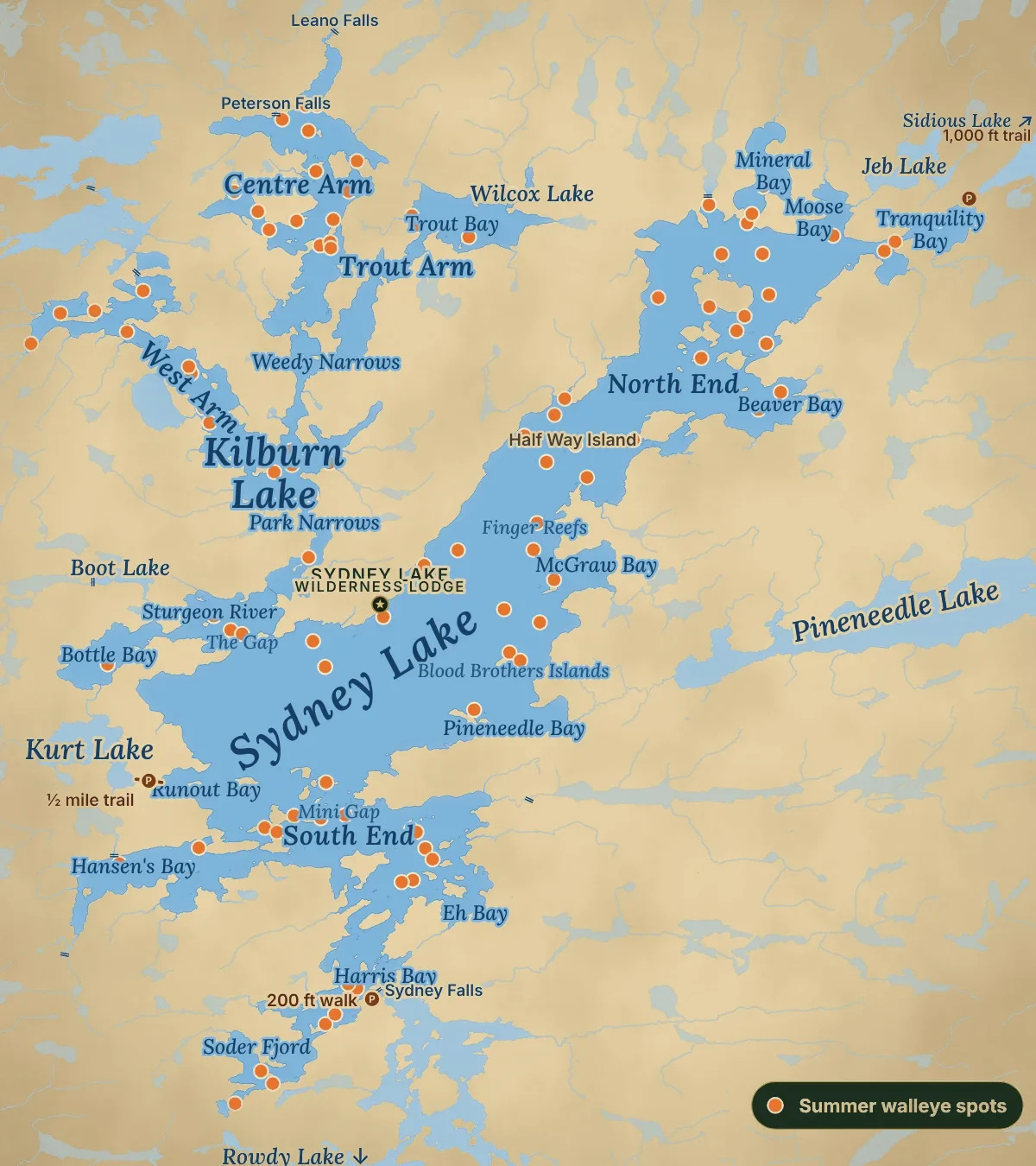
There’s no golden walleye hole. They swim with the regular walleye, so the best plan is to fish where the walleye are. Every group gets a waterproof lake map. We’ll mark these summer spots, and what’s working that week, when you arrive. Tap the map to explore.
Kilburn narrows & bays
Current brings in baitfish, and walleye stay shallow here right through July. Kilburn’s water is darker and tea-stained.
The Gap
Where the Sturgeon River enters Sydney: a 5-foot ridge with 80 feet on one side and 200 on the other. Fish 18–25 feet.
Finger Reefs & Blood Brothers
Minutes from camp. Reefs that drop fast into deep water, and big walleye in August.
West Arm of Kilburn
A reef with shallow water on one side and deep on the other; the walleye sit on the break. At the end of the arm, fish the rock cuts and narrows under high cliffs, with three great shore lunch spots close by.
If one comes up
You’ll have a minute of excitement and shaky hands. Plan it now, so the fish goes back strong and you still get the photo.
Landing
Every boat has a landing net
Slide the net under the fish head-first and leave it in the water while you get your pliers and camera ready. Walleye have sharp teeth, so skip the lip grip.
Tip: pinch your barbs before you start fishing.
Hook out
Pinched barbs come out fast
Use long-nose pliers and back the hook out the way it went in. If it’s hooked deep, cut the line close to the hook rather than digging for it.
Tip: single hooks make releases quicker.
Holding
Level, with the belly supported
Wet your hands, hold the fish level with one hand under the belly and one near the tail, and keep your fingers out of the gills. Never hang a big walleye by the jaw.
Tip: keep it low, so a slip is a soft one.
Release
Upright, head into the water
Hold it upright in the water, facing into any current or waves, until it kicks out of your hands on its own. Fish pulled up from deep water can struggle, so get it back quickly.
Tip: the less time out of water, the better.
Photos
Before the fish leaves the water
Hand a phone to your partner, make sure it’s unlocked and in camera mode, then lift the fish. Fire off a burst, then take a short video of the release.
Tip: burst mode catches the best frame.
Photos
Bright sun can wash out gold
Turn so the sun is behind the photographer or off to the side, or shoot in open shade. Early morning and evening light make a gold fish glow.
Tip: tap the fish on screen to set the exposure.
Photos
Nose to tail, plus your face
Hold it in front of your chest, not at arm’s length, and keep the whole fish and your head in the frame. Add a close-up of the colour and the white tail tip.
Tip: two or three good shots is plenty.
Big ones
Register it at camp
Measure it quickly, nose to tail. A walleye 27 inches or longer can be registered at camp with a witness and a photo. The biggest walleye of the season across Ontario’s Trophy Waters wins a free trip the next year.
Tip: a golden walleye counts too.


Catch and release
We’ve practised conservation fishing on Sydney Lake since 1987, and our lakes are part of Ontario’s Trophy Waters. There’s one lodge, no roads, no cottages and no stocking. A golden walleye follows the same camp rule as any walleye: keep 2 a day, 18 inches or under. Anything bigger goes back to keep growing, so someone else gets the moment you just had.
Keep a couple of regular walleye for shore lunch instead. Our camp rule is 2 walleye, both 18 inches or under. Every cabin has a shore lunch kit, and propane cookers are ready at the dock.
Ontario’s official limits for the Sydney Lake area are on our licences and limits page. Regulations change, so check the current Ontario fishing regulations before your trip.
Ontario’s Trophy Waters →Licences & limits →
Golden walleye FAQ
A golden walleye is a walleye with a rare, natural colour condition called xanthochromism, or xanthism. It has lost most of its darker pigment, so it looks yellow from nose to tail. It’s the same species as every other walleye, not a hybrid and not a sauger.
They’re real. People often think our photo has been edited because the colour looks so unnatural. It hasn’t. It’s a walleye that came up solid gold on Sydney Lake.
Rare. Most trips won’t see one, and we can’t promise one. Walleye are the main course here, with good numbers and a bigger-than-average size. A golden walleye is the dessert.
You can book a walleye trip, and that’s what we recommend. No one can guarantee a golden walleye. Come for the walleye fishing, and if a gold one shows up, it’s a bonus.
Yes, if it fits our camp rule: 2 walleye a day, both 18 inches or under. Anything bigger goes back alive. We’ve practised conservation fishing on Sydney Lake since 1987.
Walleye colour varies with the clarity and tint of the water they live in. In darker, tea-stained lakes, normal walleye often look deep gold. A true golden walleye goes further: it’s missing most of its dark pigment.
A golden walleye is missing its dark pigment. A blue walleye has a blue pigment, sandercyanin, in the slime on its back, and turns up in some Canadian Shield lakes. Neither is the Great Lakes blue pike, which was declared extinct in 1983.
On Sydney Lake, at our lodge, in 2024. You can watch it near the top of this page.
Come for the walleye. Keep your camera ready for the gold.
Walleye fishing →Why these lakes →Check dates →