Woodland Caribou Provincial Park · Ontario
Sydney and Kilburn Lakes sit inside the south end of Woodland Caribou Provincial Park, one of Ontario's largest wilderness parks. No roads reach them and ours is the only lodge on either lake. You get the fishing, the wildlife and the quiet of the park without having to paddle and portage for a week to find it.


Woodland Caribou Park Sign, Sydney Lake
1.1M+
acres of protected wilderness
About 470,000 hectares of Canadian Shield lakes, rivers and boreal forest, managed by Ontario Parks since 1983.
<1,000
paddlers a season, park-wide
Most visitors are canoe trippers out for a week or more. You fly straight to a cabin and a boat.
#1
largest lake in the park
Sydney Lake covers about 14,000 acres, nearly twice any other lake in Woodland Caribou. Ours is the only lodge on it.
2018
UNESCO World Heritage
The park is part of Pimachiowin Aki, a World Heritage Site shared with four First Nations and Manitoba.

Inside the park
Woodland Caribou Provincial Park runs from near Red Lake west to the Manitoba border, where it joins Manitoba’s Atikaki Provincial Park. At about 470,000 hectares it’s one of Ontario’s biggest wilderness parks, with roughly 2,000 km of canoe routes and fewer than 1,000 paddlers a year. Sydney and Kilburn Lakes sit at its southern edge. At about 14,000 acres, Sydney is the largest lake in the park, nearly twice the size of any other, and at 240 ft it’s deeper than any park lake with a published depth survey. Together the two lakes cover 17,570 acres, joined by the Sturgeon River, with 120 islands between them.
Most people who see the park arrive by canoe and spend a week paddling and portaging between campsites. Our guests fly in by float plane from Kenora, about 30 minutes, and land at the dock in front of their cabin. Boats, motors and fuel are waiting.
Because the park is roadless wilderness, nobody trailers a boat in for the weekend. There are no launches, no cottages and no other camps on Sydney or Kilburn. The water stays as it has always been, and so does the fishing.
My family has been on Sydney Lake since 1933, decades before the park was created. We’ve watched it stay wild, and we intend to keep it that way.
Explore Sydney Lake →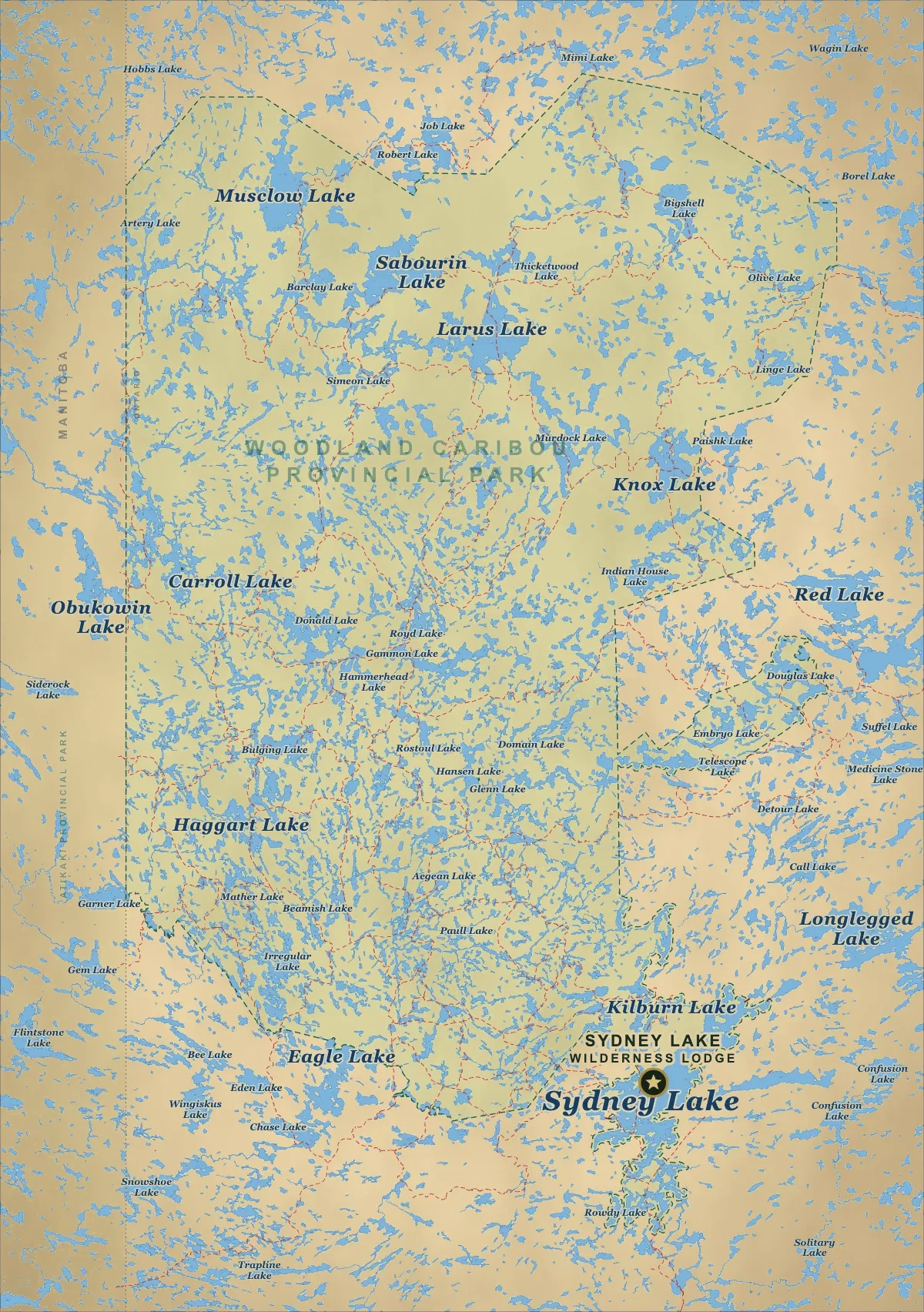
Where it is
The park runs roughly 65 miles north to south and 40 miles wide along the Manitoba border, west of Red Lake. Sydney and Kilburn Lakes are at the bottom of it, where you see the star. Click the map to open the full-screen version: switch between map and satellite view, turn place names on or off, and zoom in on the canoe routes and our portage trails.
The lodge
The star near the south end. Kenora is 60 miles south, about 30 minutes by float plane.
Park boundary
The green dashed line. Sydney and Kilburn sit inside the park's south end.
Canoe routes
The red dashes: the park's network of about 2,000 km of canoe routes, traced from the Ontario Parks map.
Satellite view
Flip the switch to see the real forest, rock and old burns from space.

Wildlife
With so few people in the park, animals here aren’t used to traffic. Guests regularly see moose, bears and eagles, and now and then wolves, foxes and the park’s namesake caribou.
Islands and mature forest
Threatened in Ontario · rare to see
Woodland caribou are a different subspecies from the barren-ground caribou of the tundra. They live in old forest and feed on lichens and mosses, gathering in small herds in winter and splitting up to calve in late spring, often on islands and lakeshores. The park protects one of the largest groups south of Hudson Bay, and once in a while guests watch one swim between islands on Sydney.
If you see one, cut the motor, keep your distance and enjoy it.
Weedy bays, early and late
Most often seen at dawn and dusk
Moose feed in the shallow, weedy bays and along quiet shorelines, especially on the tea-stained arms of Kilburn. Cows with calves turn up in early summer. They’re big, calm and easy to photograph from a drifting boat.
Best: first light in the back bays.
Creek mouths in spring
Common in May and June
Black bears work the creeks and shorelines while the fish spawn in spring, and you’ll sometimes see one swimming across a channel. They’re wary of people and boats. At camp we keep fish waste and garbage handled properly so they stay wild.
Watch the creek mouths at the backs of the bays.
All season
Pelicans and herons too
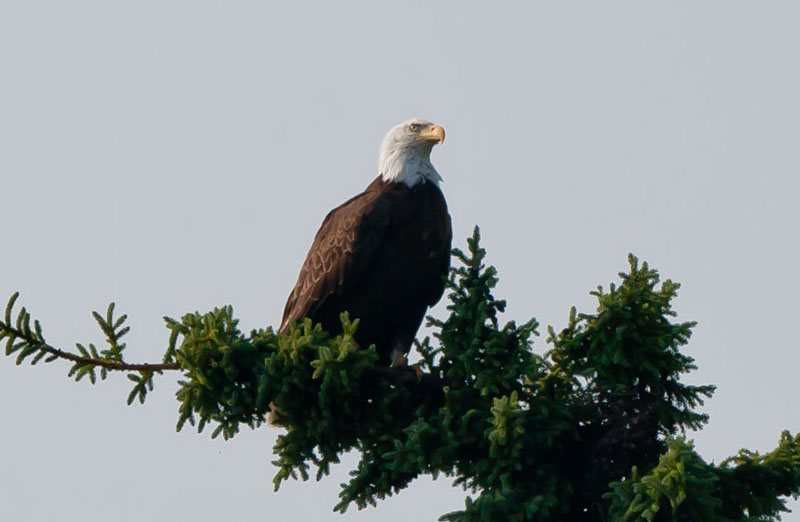
Bald eagles, osprey, pelicans and great blue herons fish right alongside you, and loons call across the lake every evening. An eagle will sometimes swoop for a fish right near the boat, and now and then it picks one too big to carry.
Tip: where the birds are hunting, the fish are active.
Wildlife on the water
This one circled over our boat on Sydney Lake, dropped to the water a few yards away and flew off with a walleye.
You don't have to go looking for wildlife in the park. Some days it comes to you.
Filmed from the boat on Sydney Lake, August 2023. Watch the full video on YouTube →





Quick answers
The short version: two big, remote lakes inside the park, one lodge, and a 30-minute float plane ride from Kenora.
Location
Yes. Sydney and Kilburn Lakes are both inside the south end of the park, north of Kenora near the Manitoba border, and inside Ontario’s Trophy Waters area. At about 14,000 acres, Sydney is the largest lake in the park, nearly twice the size of the next biggest, Carroll Lake. At 240 ft it’s also deeper than any park lake with a published depth survey.
Getting here
By float plane only. Most guests drive to Kenora, Ontario, and fly from the downtown float plane base to our dock in about 30 minutes. There are no roads to either lake.
The fishing
Walleye are the main event: lots of them, and bigger than average. Trophy northern pike and lake trout from Sydney’s 240-foot basin round it out. Big fish are released to keep the lakes the way they are.
Effort level
No. You stay in a lakeside cabin and fish from a boat with a motor. If you want a taste of the backcountry, there are portage lakes nearby with boats waiting at the end of the trail.
History
Long before it was a park, this was Anishinaabe country, and it still is. Archaeology on the Bloodvein River shows people living here for at least 9,000 years, and red ochre pictographs, many of them centuries old, are painted on rock faces across the park. Fur traders worked the Red Lake country from the late 1700s. In 2018 the park became part of Pimachiowin Aki, Canada’s first mixed natural and cultural UNESCO World Heritage Site, recognizing both the boreal forest and the four Anishinaabe First Nations who have cared for it.
About the World Heritage Site →Explore more: Sydney Lake · Kilburn Lake · Portage lakes · Ontario’s Trophy Waters · Walleye