How to catch lake trout · Mid-May to September

How to Catch Lake Trout: A Month-by-Month Guide

Lake trout follow the cold water: shallow in spring, deep in summer, back on the rocks in September. Here’s where to find them each month and what to drop down to them. — Jeb

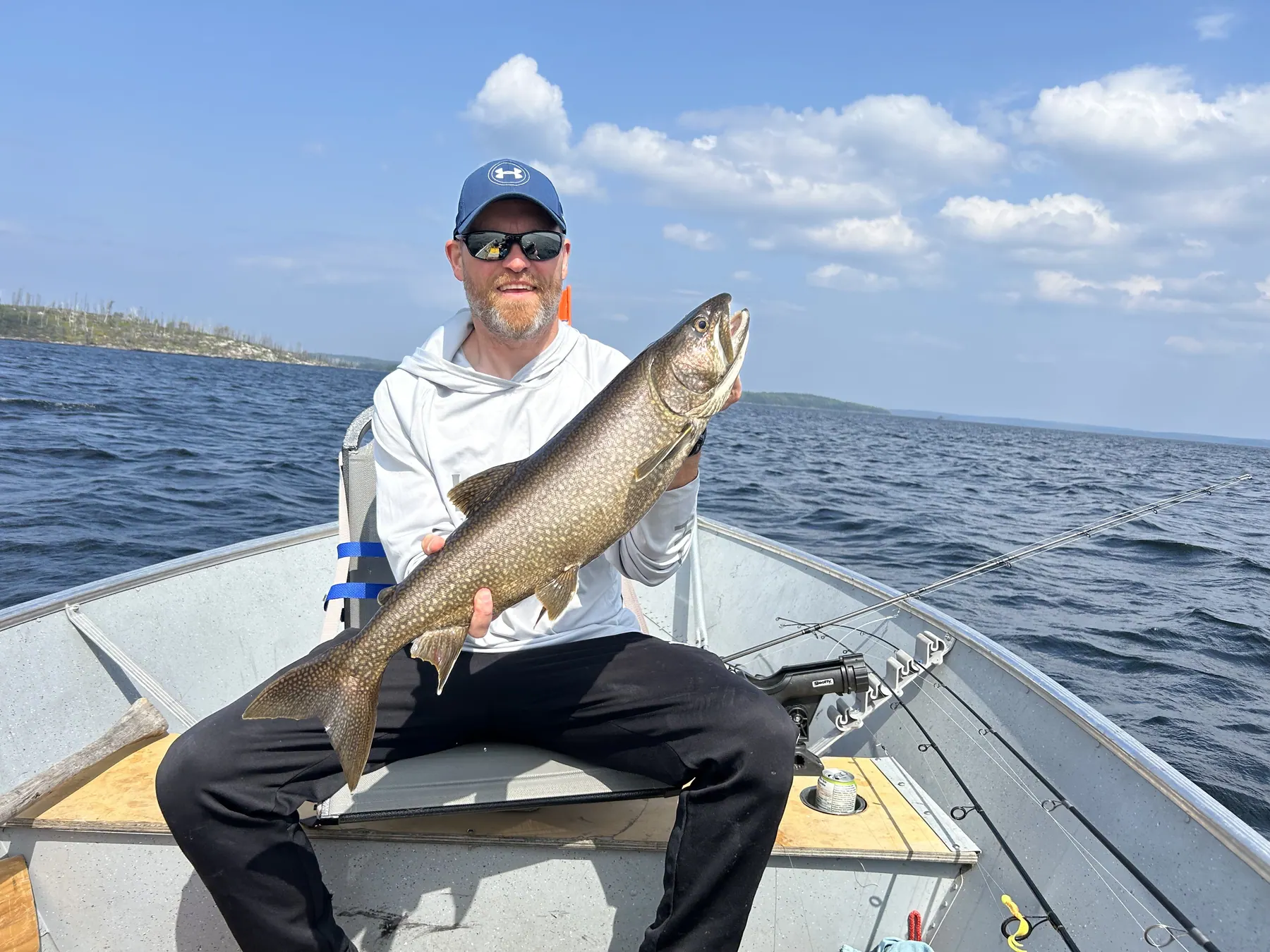
Angler holding a lake trout from Sydney Lake's deep water at sunset

Start here

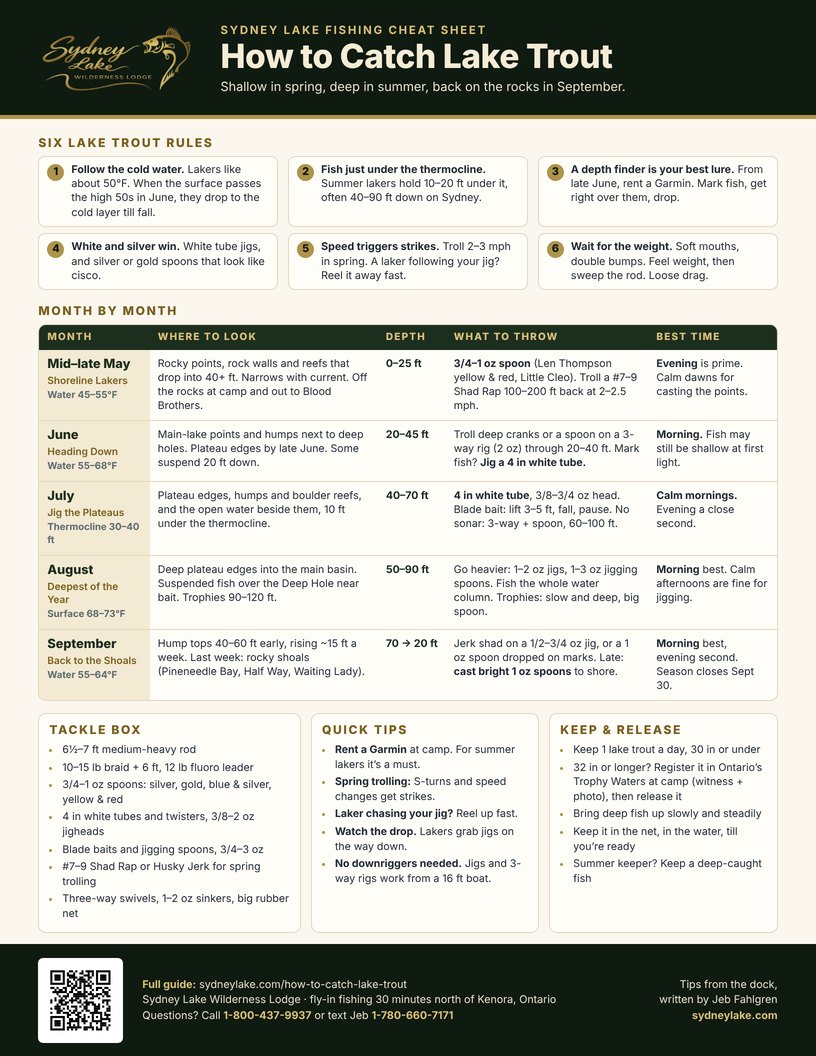
Six Lake Trout Rules That Work All Season

Lakers are simpler than they look. Get these six down and the monthly game plans below will make sense.

1

Follow the cold water

Lakers like water around 50°F. When the surface warms past the high 50s in June, they head down to the cold layer and stay there until fall.

2

Fish just under the thermocline

In summer a layer of warm water sits on top of cold. Lakers hold in the 10 to 20 feet just under it, often 40 to 90 feet down on Sydney.

3

A depth finder is your best lure

From late June on, rent a Garmin at camp. Mark the fish or the bait, put the boat right over them, then drop.

4

White and silver win

White tube jigs, and silver or gold spoons that look like cisco, are the most-repeated lake trout baits there are.

5

Speed triggers strikes

Troll fast in spring, 2 to 3 mph. If a laker follows your jig on the screen, reel it away fast. They hate letting a meal escape.

6

Wait for the weight

Lakers often bump a lure twice and have soft mouths. Wait until you feel weight, then sweep the rod. Don’t jerk, and keep your drag loose.

Month by month

Where Lake Trout Are, Month by Month

Pick your month for the game plan: where to look, how deep, what to throw and when to go.

DEPTH (FEET) →Most fishSome fish / trophies0306090120May0–25 ftJune20–45 ftJuly40–70 ftAugust50–90 ftSeptember70 → 20 ft

Depths are where most lakers sit on Sydney Lake. In summer the cold layer sets the depth, so find the thermocline on your depth finder and fish just below it.

Mid–late May · Water 45–55°F

Shoreline Lakers

Right after ice-out the whole lake is cold, so lake trout cruise the shallows. It’s the easiest month to catch one, even from shore at camp.

Depth0–25 ft
WhereRocky points
Best timeEvening
Go-to lureSpoons

Where to look

  • Rocky points, rock walls and reefs that drop fast into 40+ ft of water.
  • Narrows with current between islands, and the mouths of bays where baitfish gather.
  • Right off the rocks at camp, and along the run from camp to the Blood Brothers Islands.

What to throw

  • A 3/4–1 oz spoon (Len Thompson yellow and red, Little Cleo, Williams). Cast, let it sink a few seconds, and reel with pauses.
  • Troll a #7–9 Shad Rap, Husky Jerk or spoon 100–200 ft behind the boat at 2–2.5 mph.
  • A white 1/4–3/8 oz bucktail jig or a 4–5 in swimbait cast along the rocks.

When to go

  • 🌅 Morning: calm dawns are great for casting off the points.
  • ☀️ Afternoon: troll a little deeper, 15–30 ft, as the sun climbs.
  • 🌙 Evening: prime time. Lakers often feed right up at the surface.

Jeb’s play

Troll a spoon way back and keep changing it up: speed up, slow down, make S-turns. The change in speed is what gets the strike. Keep your drag loose.

June · Water 55–68°F

Heading Down

As the surface warms, lakers slide deeper. Early June can still be shallow at first light. By late June they’re under the warm water for the summer.

Depth20–45 ft
WherePoints and humps
Best timeMorning
Go-to lureTroll, then jig

Where to look

  • Main-lake points and humps that top out shallow next to deep holes.
  • The edges of big underwater flats (plateaus) by late June.
  • Some fish suspend about 20 ft down over deeper water.

What to throw

  • Troll a deep-diving crankbait, or a spoon on a three-way rig with a 2 oz weight, through the 20–40 ft band.
  • When you mark fish, stop and jig a 4 in white tube or a 4–5 in plastic on a 3/8–3/4 oz head.
  • Early in the month, May’s spoons still work at dawn.

When to go

  • 🌅 Morning: best, and fish may still be shallow at first light.
  • ☀️ Afternoon: go deeper and jig the edges.
  • 🌙 Evening: good as the light fades.

Jeb’s play

Start on your May spots and work out deeper. The shallow bite only lasts a few weeks, so follow the fish down the drop.

July · Thermocline about 30–40 ft

Jig the Plateaus

Summer lake trout live in the cold layer under the thermocline. Find it and jigging them is a blast: just like walleye fishing, only deeper.

Depth40–70 ft
WherePlateau edges
Best timeCalm mornings
Go-to lureWhite tube jig

Where to look

  • Edges of big flat plateaus where they drop deeper, plus humps and boulder reefs.
  • The open water right beside structure, not just on top of it.
  • The 10 ft just below the thermocline, even over deeper water.

What to throw

  • A 4 in white tube on a 3/8–3/4 oz jighead, or a white twister tail on a 1/2–1 oz head.
  • A 3/4–1 oz blade bait or jigging spoon: lift 3–5 ft fast, let it fall on a tight line, pause.
  • No depth finder? A three-way rig with a 1–2 oz sinker and a spoon on an 8–10 ft leader, trolled slowly through 60–100 ft.

When to go

  • 🌅 Morning: best, especially when it’s calm.
  • ☀️ Afternoon: jigging still works on calm, bright days.
  • 🌙 Evening: a close second to morning.

Jeb’s play

Hold the boat right over the fish: slip the motor in and out of gear and watch your jig on the screen. If a laker chases it but won’t bite, reel up fast. They hate letting a meal get away.

August · Surface water 68–73°F

Deepest of the Year

Lakers are at their deepest. Many sit on deep edges, and some of the biggest suspend over the open basin near the cisco.

Depth50–90 ft
WhereDeep edges, basin
Best timeMorning
Go-to lureHeavy jig or spoon

Where to look

  • Deep plateau edges where they drop into the main basin.
  • Fish suspended over the Deep Hole and open water, near clouds of bait.
  • Trophies often sit 90–120 ft down.

What to throw

  • Go heavier: 1–2 oz jigheads with white tubes or plastics, or 1–3 oz jigging spoons in wind or deep water.
  • Fish the whole water column: 5 minutes near bottom, then move up 10 ft at a time. Go back to the depth of your first bite.
  • For trophies, troll slow and deep with 3–6 oz of weight and a big spoon or 8 in Flatfish.

When to go

  • 🌅 Morning: best.
  • ☀️ Afternoon: calm, bright afternoons are fine for jigging.
  • 🌙 Evening: good.

Jeb’s play

Watch the screen as your jig falls. Lakers often grab it on the way down, so stay ready the whole drop. And bring deep fish up slowly.

September · Water 55–64°F

Back to the Shoals

Lakers start their climb toward the fall spawning reefs and feed hard on the way. The month starts deep and ends with fish on the rocks, and some of the heaviest lakers of the season.

Depth70 → 20 ft
WhereHumps, then shoals
Best timeMorning
Go-to lureJig, then bright spoon

Where to look

  • Early in the month: hump tops 40–60 ft deep and points next to deep water.
  • They rise about 15 ft a week as the water cools.
  • Last week: boulder patches, reefs and rocky shores like Pineneedle Bay, Half Way and Waiting Lady Islands, and the islands by the Deep Hole.

What to throw

  • A 4–6 in jerk shad on a 1/2–3/4 oz jig, or a 1 oz spoon or blade bait dropped right onto fish you mark.
  • Late in the month, cast bright 1 oz spoons (Little Cleo, Len Thompson) toward shore and work them back out.
  • Troll 25–45 ft along points and shoals.

When to go

  • 🌅 Morning: best of the day.
  • ☀️ Afternoon: good on calm, clear days.
  • 🌙 Evening: late afternoon into evening is a close second.

Jeb’s play

The season closes September 30, so make the last week count: pound the rocky shoals at first light. Most big September lakers are full of eggs, so snap a photo and let her go.

Tackle

Your Lake Trout Tackle Box

You don’t need downriggers or a big boat. This fits in one tackle box and covers the whole season. See the full packing and tackle list.

The setup

  • 6½–7 ft medium-heavy rod with a baitcaster or spinning reel.
  • 10–15 lb braid with a 6 ft, 12 lb fluorocarbon leader.
  • Keep the drag loose. Lakers shake their heads.
  • A big rubber net.

Lures to bring

  • 3/4–1 oz spoons: Len Thompson, Little Cleo, Williams. Silver, gold, blue and silver, yellow and red.
  • 4 in white tubes (Getzit) and white twister tails, with 3/8–2 oz jigheads.
  • Blade baits and jigging spoons, 3/4–3 oz.
  • #7–9 Shad Raps or Husky Jerks for spring trolling.

Extras that help

  • Rent a Garmin Striker at camp, $15–25 a day. For summer lakers it’s a must.
  • Three-way swivels and 1–2 oz sinkers for deep trolling.
  • A descending device if you’ll fish 90 ft or deeper.
  • Polarized sunglasses for spotting fish on the shallow rocks in spring and fall.

Myths and mistakes

Lake Trout Mistakes to Skip

✕

“You need downriggers”

You don’t. Spring casting and trolling, summer jigging and simple three-way rigs all work from a 16 ft boat.

✕

“Lakers sit on the bottom”

In summer many suspend in open water. Watch the whole screen, not just the bottom.

✕

“Slow is always better”

Fast spring trolling and a quick reel-away trigger plenty of strikes.

✕

Fishing deep water blind

Without a depth finder you’re guessing in 60 ft of water. Rent one at camp.

✕

Jerking the hook set

Lakers have soft mouths and often bump twice. Wait for weight, then sweep the rod.

✕

“It swam away, it’s fine”

Lakers from deep water can die later. Bring them up slowly and get them back in fast.

Keep and release

Keep One for Lunch. Let the Big Ones Go.

The rules at camp

  • Keep 1 lake trout a day, 30 in or under. Every bigger laker goes back.
  • Lakers 32 in or longer can be registered in Ontario’s Trophy Waters at camp with a witness and a photo, then released.
  • Sydney Lake guests have caught the biggest registered laker in Trophy Waters six times since 2014, up to 41 in.

Releasing a deep laker

  • Bring fish up slowly and steadily from deep water.
  • Leave it in the net, in the water, while you get the camera and pliers ready.
  • Hold it level and support the belly. Keep it out of the water no longer than you can hold your breath.
  • In summer, if you’re keeping one, keep a deep-caught fish under 30 in. Spring and September are the best times to release a trophy.

Keep reading

More Ways to Plan Your Fishing